Bitcoin Crosses $100K: Arbitrage Dynamics in a Six-Figure Market
Bitcoin first crossed $100,000 on December 5, 2024, closing at $103,679. Seven weeks later, the market has settled into a new structural regime. Here is what the arbitrage landscape looks like at six figures.
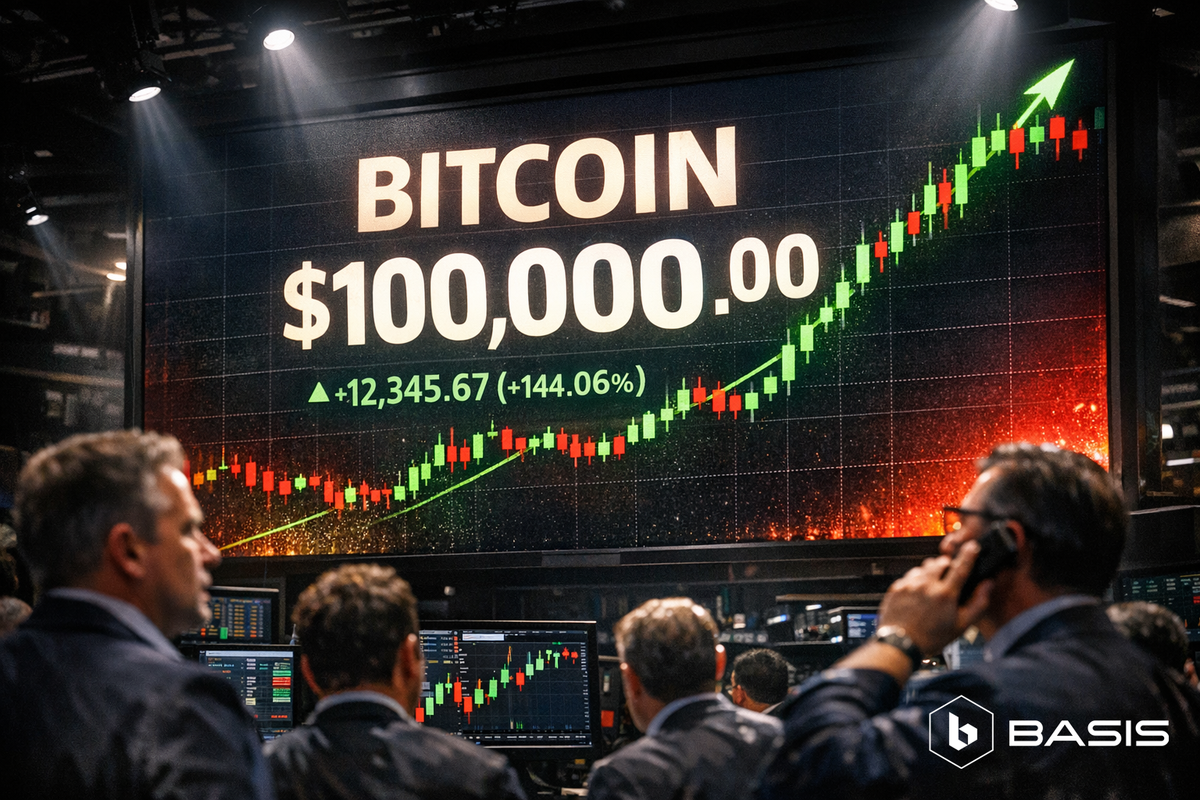
Bitcoin at $100,000 did not just add another zero to the headline price. It changed the way the market clears risk. Since BTC first broke six figures on Dec. 5 and closed that day at $103,679, arbitrage has become less about catching obvious retail dislocations and more about managing balance sheet, funding stress and cross-venue inventory in a market now shaped by ETFs, CME basis desks and a much larger options complex.
The $100,000 line changed the market’s plumbing
Round numbers matter in every asset class, but in bitcoin they become microstructure. The move through $100,000 concentrated attention, liquidity and positioning around a single number in a way that earlier highs did not. In 2021, the market’s all-time high near $69,000 still felt like a crypto-native milestone. At $100,000, bitcoin became a macro asset with a clean headline number that institutions could underwrite, hedge and explain to committees.
That shift showed up first in participation. U.S. spot ETF approval in January 2024 pulled in a new class of long-only buyer, and by the end of 2024 those products had absorbed more than $35 billion in net inflows. The result was a spot market increasingly driven by creation activity during U.S. hours, while leverage and price discovery remained concentrated in perpetual swaps and listed options. That split matters: when one side of the market buys spot for allocation and the other side finances directional exposure through derivatives, arbitrage capital becomes the bridge.
The options market also changed character once $100,000 became live rather than theoretical. On Deribit, open interest around the $100,000, $110,000 and $120,000 call strikes became central to short-term price behavior into year-end expiry. Dealers were no longer hedging around an abstract upside target; they were managing delta and gamma around the most visible strike cluster on the board. That tends to compress intraday moves near major strikes and then amplify breaks once those hedges roll off. In other words, six figures made bitcoin trade a little more like an index around expiry and a little less like a pure momentum token.
Funding rates became the price of bullishness
The cleanest signal of this new regime was funding. In the hottest stretches of late November and early December, 8-hour funding on major offshore perpetual venues repeatedly traded in the 3 to 8 basis-point range, with isolated bursts higher depending on venue and time of day. Annualized, that works out to roughly 33% to 88%, and sometimes more in short spikes. That is not a trivial premium. It is a tax on impatience.
At six figures, bullish traders were willing to pay up to stay levered long because the psychological break above $100,000 carried its own momentum. But that is exactly when market-neutral capital tends to step in. When perp funding pushes that high, the trade is straightforward: own spot or spot proxy inventory, short the perpetual, collect the carry and stay indifferent to direction.
The important point is that ETF inflows can intensify this pattern rather than suppress it. ETFs buy spot; they do not absorb leverage. Heavy ETF demand tightens the available float on exchanges and can lift spot relative to derivatives, especially during U.S. sessions with strong subscriptions. Traders anticipating those flows often express the view through perpetuals and short-dated calls. That pushes funding and front-end implied volatility higher. So the ETF complex can create a slower, steadier spot bid at the same time that derivatives become more expensive to own outright.
That dynamic was visible in December. Multiple sessions saw very strong U.S. ETF demand while offshore perpetuals stayed richly positive. The market was effectively paying arbitrage desks to warehouse spot and short leverage against it.
The basis trade still worked, but the menu widened
At $100,000, the basis trade did not disappear. It became more segmented.
Quarterly futures and perpetual swaps started pricing different things. Quarterly basis on regulated and offshore venues spent stretches of December in the low-to-mid teens annualized, occasionally richer during the breakout, before cooling into January as the outright move stalled. Perpetuals, by contrast, offered more episodic but often higher carry because funding reacts immediately to one-way positioning. That gave traders a choice:
- Short quarterly futures against spot for a cleaner, locked-in carry profile with lower path dependency.
- Short perpetuals against spot for potentially higher yield, but with funding that can compress quickly once momentum fades.
- Arbitrage the spread between CME and offshore venues when regulated capital and crypto-native leverage price risk differently.
For many institutions, CME remained the preferred basis venue even when gross carry was lower than offshore alternatives. The reason is obvious: regulated counterparty exposure, clearer margin treatment and easier integration with existing risk systems. Offshore perps could pay more, especially when retail and high-beta funds chased breakouts, but the balance-sheet haircut is larger. At six figures, gross yield stopped being the only variable. Counterparty quality and capital efficiency mattered more.
Position sizing is now a first-order risk variable
Six figures also changed the arithmetic of risk. A 1% move in BTC is now $1,000 per coin. A 5% day is $5,000. For a desk running 100 BTC of inventory, that is a $500,000 daily swing on a fairly standard volatile session. At the 2021 peak near $69,000, the same 5% move was about $3,450 per coin.
That means coin-based position limits become less useful and dollar-based limits become more important. Market makers can show fewer BTC at the top of book while committing the same or greater notional risk. Funds that were comfortable trading in whole-coin terms at lower prices now have to think more like rates or FX desks: in VaR, margin consumption and liquidation distance.
This is one reason directional exposure becomes structurally more expensive at all-time highs. It is not just that funding is rich. It is that the same coin position now carries larger dollar volatility, larger margin swings and higher operational cost if hedges need to be rolled fast.
Liquidity is deeper in dollars, not always in bitcoin
Compared with previous cycle highs, the six-figure market looks stronger in dollar terms but not uniformly thicker in coin terms. Spreads on major venues have generally been tighter than during earlier manias, and the combination of ETFs, CME, principal trading firms and larger options books has made it easier to transfer very large dollar risk. But visible exchange depth can appear thinner in BTC because no one needs to show as many coins to show the same notional.
A 300 BTC resting order at $100,000 is a $30 million quote. In 2021, a desk needed materially more coin to represent that same risk appetite. So comparing order-book depth only in BTC can give a false impression of deterioration. The real comparison is executable dollars across spot, futures, blocks and ETF-related liquidity.
That said, fragmentation has increased. Some of the deepest liquidity no longer sits on lit crypto books. It sits in CME futures, OTC blocks, internalized flow and ETF creation-redemption channels. For arbitrageurs, that creates more edge but also more operational complexity. Best execution is no longer a single venue problem.
Why market-neutral looks better at all-time highs
The structural case for market-neutral strategies is strongest when the market is most excited. At new highs, outright longs are often paying through the nose: positive funding, rich call skew, elevated front-end basis and bigger notional swings per coin. In that environment, the cleaner trade is often to sell the excitement rather than join it.
Base58 Labs, a London-based quantitative research group, argues that high-price regimes widen the gap between slow spot demand and fast derivatives hedging. That gap is where structural alpha appears: in funding dispersion, term-structure dislocations and inventory imbalances across venues, not in heroic directional calls.
That diagnosis fits the tape since Dec. 5. Bitcoin above $100,000 is not a market where arbitrage disappears because the asset is “too big.” It is a market where arbitrage becomes more institutional, more balance-sheet intensive and, in many cases, more attractive than naked directional risk.
The next phase will depend on whether ETF inflows remain persistent enough to keep spot tight while leverage rebuilds in derivatives. If they do, funding and basis will stay rich enough to reward disciplined carry trades. If they do not, the carry will compress and the edge will shift toward cross-venue and options-relative-value setups. Either way, the six-figure bitcoin market is no longer defined by whether the asset can rally. It is defined by who gets paid to finance that rally.