Expanding the Arbitrage Universe: ETH, SOL, and PAXG Now Live
BASIS now supports ETH, SOL, and PAXG alongside BTC. The expansion from single-asset to multi-asset arbitrage infrastructure is not additive—it is multiplicative. Here is why the full asset set matters for structural alpha.
Expanding the Arbitrage Universe: ETH, SOL, and PAXG Now Live
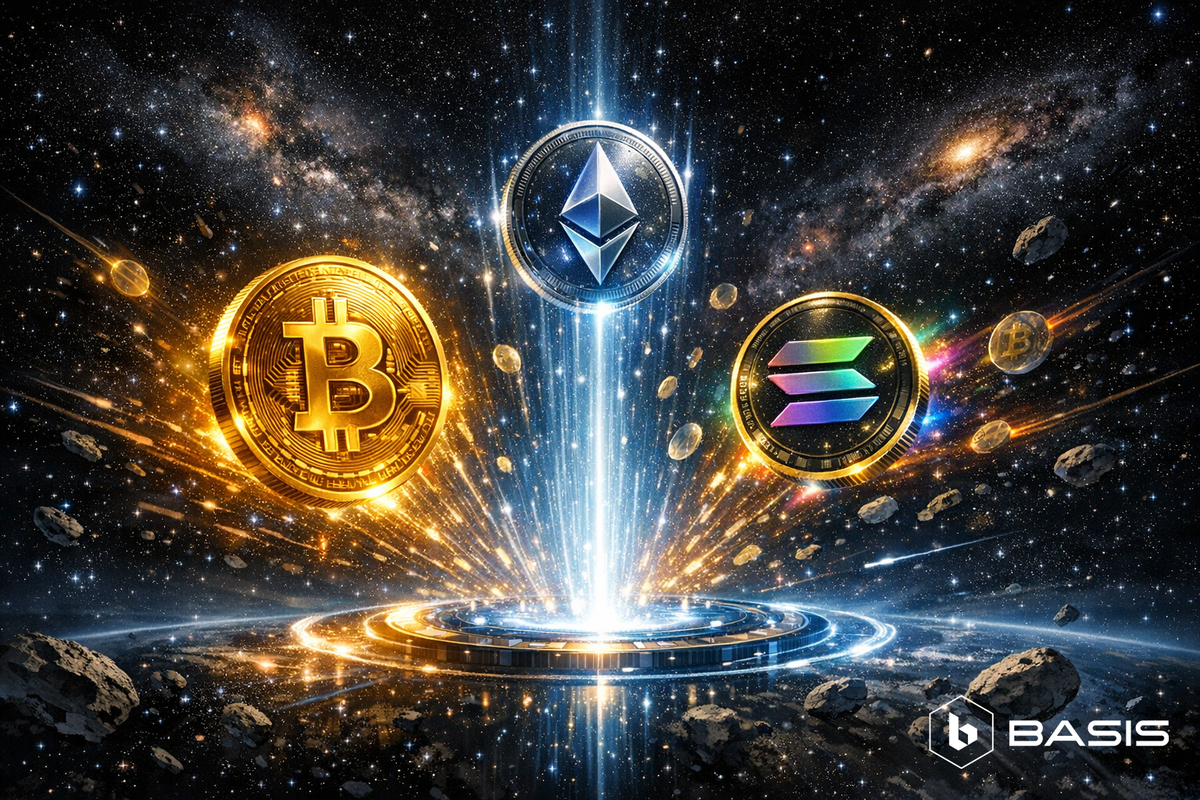
March 10, 2026 — BASIS has moved beyond its original Bitcoin-only launch profile and opened support for ETH, SOL, and PAXG, a step that materially changes how the platform can source returns. In practical terms, the expansion introduces stETH, stSOL, and stPAXG alongside the already live stBTC, each minted on a 1:1 basis from the underlying asset. Strategically, however, this is less about adding three more tickers than about broadening the opportunity set for market-neutral and low-directionality yield generation across distinct market structures.
That distinction matters. Arbitrage businesses rarely fail for lack of ideas; they fail because the opportunity set is too narrow, capital cannot be reallocated quickly enough, or the operating stack cannot handle execution complexity across venues and chains. BASIS is now positioning itself against all three constraints at once: wider asset coverage, more flexible inventory deployment, and a low-latency infrastructure layer designed to execute in fragmented crypto markets where basis, funding, and venue dislocations are often short-lived.
From a single-asset proof point to a broader platform
BASIS is operated by BASIS DIGITAL INFRASTRUCTURE LTD, a Seychelles International Business Company incorporated on February 4, 2026, with London-based Base58 Labs serving as its research partner. That corporate structure is relevant because the platform is clearly trying to present itself not as a retail yield front end, but as an infrastructure-led arbitrage venue with research, execution, and governance separated into recognizable institutional functions. For allocators evaluating crypto basis products, that separation often matters as much as headline APYs.
At the center of the platform sits the BHLE engine, which BASIS says is built for sub-50 microsecond latency and more than 100,000 operations per second. Those numbers are not cosmetic. In arbitrage, especially in cross-exchange and derivatives-linked strategies, latency and throughput are directly tied to edge retention. When spreads compress in seconds and order books reprice in milliseconds, software performance becomes a core economic variable. The move into ETH, SOL, and PAXG suggests BASIS believes its stack is mature enough to monetize that performance beyond BTC.
The asset expansion: why these three matter
The newly live wrappers are straightforward in construction but meaningful in market coverage. BASIS now supports the following stToken universe:
- stBTC, already live, convertible 1:1 from BTC.
- stETH, convertible 1:1 from ETH, extending the platform into Ethereum’s post-Pectra execution environment.
- stSOL, convertible 1:1 from SOL, bringing in Solana’s high-throughput execution economy.
- stPAXG, convertible 1:1 from PAXG, adding tokenized gold exposure to a previously crypto-native strategy set.
Each wrapper broadens the addressable market in a different way. ETH adds depth across spot, perpetuals, lending, and DeFi collateral markets. SOL adds exposure to one of the fastest-moving funding and venue-fragmentation ecosystems in crypto, where liquidity can be deep but highly reactive. PAXG is the outlier, and arguably the most strategically interesting addition: it introduces a gold-linked instrument whose return drivers and liquidity cycles are often distinct from those governing the major crypto pairs.
Seen together, the expansion creates a more resilient inventory base. BTC remains the natural anchor for institutional crypto arbitrage, but a platform tied only to BTC can be hostage to Bitcoin-specific funding regimes and basis compression. Adding ETH, SOL, and PAXG means BASIS can rotate not only between venues, but also between market structures.
Why multi-asset support creates structural alpha
The strongest argument for this launch is cross-asset funding rate arbitrage. Funding is not uniformly rich across the market. There are long stretches when BTC perpetual funding is subdued because positioning is balanced, while ETH or SOL funding remains elevated due to sector rotation, idiosyncratic narratives, or concentrated leverage. A single-asset platform can only wait for BTC spreads to improve; a multi-asset platform can redeploy capital into the asset where the carry is currently paying.
That flexibility turns alpha from episodic to structural. Instead of depending on one asset’s derivatives market to remain inefficient, BASIS can scan across multiple pools of leverage demand and harvest whichever is most favorable after fees, collateral costs, and execution risk. This matters in 2026 because crypto arbitrage is increasingly a problem of portfolio construction rather than one-trade discovery. The edge is not merely identifying a rich spread; it is having the rails to move inventory there before the spread disappears.
The second advantage is diversification of yield streams. Gold-based strategies linked to PAXG often behave independently from crypto’s momentum-driven cycles. When broad crypto sentiment weakens and funding compresses across BTC and ETH, tokenized gold can retain a different set of drivers, including macro hedging demand, commodities positioning, and non-crypto balance sheet behavior. That makes stPAXG more than a novelty asset. It can serve as an uncorrelated sleeve in a strategy book otherwise dominated by digital-asset beta and exchange leverage dynamics.
The third advantage is liquidity allocation flexibility. A platform with four supported assets can manage idle inventory more efficiently, rotate collateral to the highest-risk-adjusted opportunities, and smooth utilization through changing market regimes. This is especially important for market-neutral products, where return consistency often depends less on any single spread and more on keeping capital continuously engaged in acceptable opportunities. Multi-asset support raises the probability that at least one sleeve of the market is paying at any given time.
How BHLE’s architecture matters in a multi-chain setting
The trade-off for this broader opportunity set is operational complexity. Bitcoin, Ethereum, and Solana are not interchangeable networks; they differ in transaction models, finality assumptions, fee dynamics, wallet abstractions, and integration patterns. A system that can route across all three simultaneously must normalize these differences without sacrificing execution speed. That is where BHLE becomes more central to the investment case than the wrappers themselves.
At a high level, BHLE appears designed to run chain-specific connectors and venue adapters in parallel while feeding a common execution and risk layer. On Bitcoin, routing must account for UTXO-based transaction construction and the slower, more deliberate settlement profile of the network. On Ethereum, the engine has to operate inside a post-Pectra environment where EVM compatibility, gas pricing, and smart-contract interactions shape the economics of moving capital. On Solana, the challenge shifts toward managing very high-throughput execution, faster state changes, and application-specific liquidity venues. The value of the engine is its ability to turn those very different operating conditions into a unified decision framework.
In practice, that means simultaneously evaluating venue prices, funding curves, collateral availability, chain transfer costs, and time-to-settlement before committing capital. It also means maintaining continuous inventory awareness: how much BTC, ETH, SOL, and PAXG is free to deploy, what portion is locked in strategies, and where rebalancing is cheapest and fastest. Sub-50 microsecond latency and 100,000-plus operations per second matter because the platform is not merely matching orders; it is arbitrating among venues, chains, and strategy sleeves under tight timing constraints.
For institutions, the key point is that multi-chain routing is not a user-interface feature. It is a balance sheet technology. If BASIS can reliably abstract the operational differences across Bitcoin, Ethereum, and Solana while preserving execution quality, it has effectively increased the number of tradable dislocations available to every dollar on the platform.
A four-by-four strategy matrix is now in place
With four supported stTokens and four named yield sources, BASIS now has what is effectively a four-by-four allocation matrix. The yield sleeves are:
- Spatial arbitrage, capturing price differences across venues and market centers.
- Funding rate capture, harvesting perpetual swap imbalances where longs or shorts pay carry.
- DeFi lending, deploying inventory into on-chain credit or collateral markets when rates justify the risk.
- PAXG yield, adding a tokenized-gold-linked return sleeve that broadens the platform beyond pure crypto market structure.
Not every asset-source pairing will be equally important in every market regime. stETH and stSOL may dominate funding-rate opportunities during periods of heavy speculative activity, while stPAXG may function more as a stabilizing return stream when crypto leverage cools. stBTC remains the benchmark inventory asset for basis and venue dislocations. The point of the matrix is not that every cell is always active, but that the engine can compare them continuously and allocate where expected net return is highest after friction, time, and risk controls.
Pricing, turnover economics, and the booster schedule
The platform’s published fee schedule is simple and competitive enough to support higher-turnover strategies: deposits are charged at 0%, withdrawals at 0.05%, and swaps at 0.01%. For arbitrage-oriented users, these numbers matter because gross spreads in mature crypto markets are often thin. Lower transfer and conversion friction makes a measurable difference to how much of the raw spread survives to the end investor.
- Deposit fee: 0%
- Withdrawal fee: 0.05%
- Swap fee: 0.01%
- Booster schedule across all stTokens: 14D +10%, 30D +20%, 90D +50%, 180D +100%
The duration-based booster schedule applying across stBTC, stETH, stSOL, and stPAXG is also strategically important. It gives BASIS a tool to stabilize liabilities and reduce hot-money behavior across the entire product suite, rather than only in BTC. Longer-dated inventory is more valuable to an arbitrage platform because it can be committed to strategies with fewer forced-liquidity contingencies. Extending the same schedule to all supported wrappers creates consistency in user behavior and simplifies treasury planning.
Governance and certification are part of the product now
Just as notable as the asset launch is the company’s statement that ISO/IEC 27001:2022 and ISO/IEC 20000-1:2018 certifications have recently been finalized. For an institutional audience, that is more than a compliance footnote. ISO/IEC 27001:2022 speaks to information security management, while ISO/IEC 20000-1:2018 addresses IT service management. Together, they suggest BASIS is trying to frame its offering not only as a source of yield, but as an operationally governed financial technology service.
That matters because the biggest constraint on institutional adoption in digital assets is often not strategy design but control environment. An allocator can tolerate basis risk and market-neutral complexity if operational governance is legible. Certifications do not eliminate risk, but they do create a framework for accountability around access control, incident management, change management, and service continuity. In a sector where many products still market speed without demonstrating process discipline, BASIS is clearly trying to sell both.
Strategic takeaway
The launch of ETH, SOL, and PAXG support turns BASIS from a Bitcoin-centric arbitrage proposition into a broader multi-asset return engine. That shift should be read as a strategic decision to expand the platform’s structural alpha surface: more funding curves to harvest, more venue dislocations to capture, more ways to keep capital productive when one asset’s economics weaken. The addition of tokenized gold is particularly notable because it introduces a return stream that can diversify away from crypto-native leverage cycles.
Whether the platform ultimately delivers will depend on execution quality, inventory management, and risk discipline more than on the wrappers themselves. But the direction is clear. In a market where arbitrage edge is being competed away at the single-asset level, broadening into ETH, SOL, and PAXG is a logical way to build a more durable business. BASIS is no longer just offering access to BTC-based opportunities; it is trying to become a cross-asset, multi-chain allocation layer for market-neutral digital asset yield.