Sovereign Bitcoin Makes Market Neutral More Valuable
As sovereigns lock away BTC, float shrinks and basis widens. That favors neutral operators built to capture fragmentation, not chase direction.


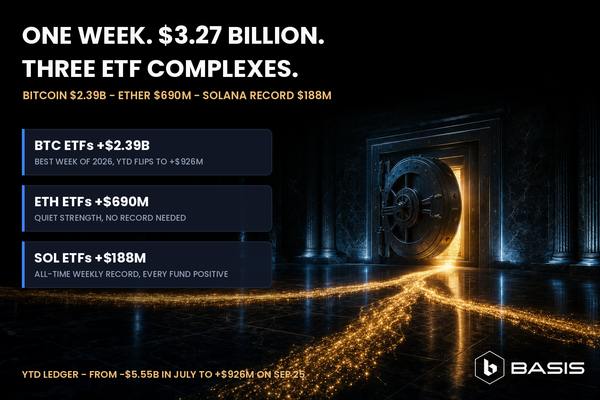
Bitcoin’s latest move higher, with BTC at roughly $93,360, up 2.68% in 24 hours, and ETH at $3,364, up 1.71%, looks ordinary only on the surface. Underneath, crypto market structure is being rewritten. Spot Bitcoin ETFs have now logged five consecutive days of net inflows through April 21. Those vehicles are already absorbing an estimated 1,000 to 2,000 BTC per week from circulating supply. Now the White House says the architecture for a U.S. Strategic Bitcoin Reserve, or SBR, is expected within two months.
That matters because the United States already controls about 328,000 BTC, worth roughly $30.6 billion at current prices. If those coins move from confiscated inventory to strategic reserve inventory, the market will not just gain a new narrative. It will lose more effective float. Brazil, Japan, and Switzerland exploring similar proposals only sharpens the point. Bitcoin is moving, slowly but decisively, from speculative asset to sovereign balance sheet asset.
From regulation to strategic ownership
For most of the past decade, the policy question was whether governments would regulate crypto. In 2026, the more consequential question is whether governments will accumulate it. That is a profound shift. Regulation shapes access. Strategic ownership shapes supply.
The U.S. SBR would matter even if Washington never bought another coin. The crucial signal is that seized or state-held bitcoin may no longer be treated as inventory available for eventual liquidation. Instead, it becomes politically sticky. Once sovereign-held BTC is framed as reserve collateral, sales become harder, slower, and more costly in policy terms.
The important shift is not simply a bigger buyer. It is the migration of bitcoin from tradable inventory into strategic inventory.
That distinction changes how traders price forward scarcity. It also changes how market-neutral operators think about inventory, borrow, and execution.
Why sovereign demand is different from ETF demand
ETF demand is already powerful, but it is still an asset-management flow. It can be created, redeemed, hedged, and arbitraged through established channels. Sovereign demand is different. It is less price-sensitive, less performance-sensitive, and far less likely to recycle quickly back into the market.
| Buyer class | Primary motive | Turnover profile | Microstructure effect |
|---|---|---|---|
| Spot ETFs | Portfolio allocation | Medium | Consistent spot absorption, authorized participant arbitrage |
| Sovereign reserves | Strategic reserve and policy signaling | Low | Float compression, lower lendable supply, stronger scarcity premium |
| Corporate treasuries | Treasury diversification | Low to medium | Episodic absorption, sentiment amplification |
A reserve wallet is not managed like an ETF basket. It is not expected to optimize carry. It is unlikely to lend aggressively. It may face legal, reputational, and national security constraints. That means the same nominal amount of BTC held by a sovereign entity has a larger impact on effective liquidity than the same amount held by an ETF ecosystem.
Float compression changes the market’s plumbing
As more BTC is removed from free circulation, market depth becomes more fragile. This does not necessarily mean permanent one-way appreciation every day. It means that smaller imbalances can produce larger price moves, and that hedging spot exposure becomes more operationally complex.
The first-order effect is thinner instantly available inventory on exchanges and with lending counterparties. The second-order effect is higher sensitivity in derivatives. If spot is harder to source, perpetual swap longs will often pay more for exposure. Funding can stay elevated for longer. Futures curves can steepen faster on policy headlines and flatten more violently when those headlines fade.
The likely result is a market with more frequent micro dislocations, not fewer. U.S. ETF creation windows, Asia open, weekend trading, and macro headline hours can all produce localized gaps between spot venues, perps, and futures. In a market where sovereigns and ETFs are both absorbing inventory, those gaps matter more because replenishment is slower.
The new inefficiencies are structural, not incidental
Market-neutral traders often thrive on temporary noise. What is forming now is more durable than noise. It is a persistent mismatch between where demand is expressed and where supply is still flexible.
One mismatch will show up in basis. As strategic demand locks away spot and offshore traders still prefer leveraged directional exposure, cash-and-carry opportunities can reappear even in otherwise mature markets. Another will show up in cross-venue fragmentation. Regulated U.S. channels, offshore derivatives venues, and bank-linked custody rails do not clear risk at the same speed or under the same constraints.
A third mismatch will emerge across assets. When bitcoin’s sovereign premium rises, investors often seek beta and rotation elsewhere. That can widen relative-value moves between BTC, ETH, and SOL, while assets like PAXG can pick up a macro hedge role during reserve-policy volatility. The opportunity set for neutral infrastructure expands because dispersion expands.
When demand becomes less economic and supply becomes less lendable, neutral strategies do not become obsolete. They become more useful.
Stablecoins and bank custody deepen the pipes
Recent U.S. policy changes strengthen this dynamic rather than weaken it. The GENIUS Act created the first federal stablecoin framework, making settlement rails more credible for institutions. Banks are now also permitted to conduct crypto custody, which lowers operational barriers for larger allocators and opens the door to more structured basis and financing activity.
At first glance, better rails should compress inefficiencies. In practice, they often redistribute them. Regulated stablecoins, bank custody, exchange collateral rules, and fund operating cutoffs do not synchronize perfectly. Institutionalization tends to increase balance sheet quality, but it also creates more segmented pools of collateral. One venue’s “good collateral” is not always another venue’s instantly deployable collateral.
That is why infrastructure matters. In a more institutional market, edge often moves away from predicting direction and toward handling latency, fragmentation, and collateral mobility more efficiently than competitors.
Why market-neutral infrastructure gains relevance
The common mistake is to assume that if bitcoin becomes more accepted, arbitrage disappears. The opposite is usually true in transitional regimes. As an asset moves into the mainstream, more capital arrives with more constraints, more mandates, and more operational friction. Those frictions are exactly what produce recurring price gaps and funding differentials.
A disciplined market-neutral operator does not need BTC to go up or down. It needs fragmented markets, asymmetric funding, and uneven liquidity. The sovereign accumulation regime provides all three. Price-insensitive spot demand coexists with leveraged derivatives demand. Policy headlines create jumps in one venue before others update. Custody and banking improvements make larger trades possible, but not perfectly synchronized. Neutral infrastructure is the layer that turns those mismatches into repeatable, hedged return streams.
Why this setup fits BASIS
This is the environment BASIS was built for. BASIS is operated by BASIS DIGITAL INFRASTRUCTURE LTD, a Seychelles IBC with LEI: 254900IX2F2KCWNSSS64. It maintains active ISO/IEC 27001:2022 and ISO/IEC 20000-1:2018 certifications, verifiable in IAF CertSearch SC62455E. Its BHLE engine is designed for market structure, not marketing slogans, with sub-50 microsecond p99 latency and 100,000+ OPS capacity.
That matters because the strategy is explicitly market-neutral, focused on capturing price gaps, funding differentials, and liquidity fragmentation across venues and instruments. In a world where sovereigns, ETFs, banks, and stablecoin rails all reshape effective float, those are precisely the inefficiencies that become more persistent. BASIS supports BTC, ETH, SOL, and PAXG, which is a practical mix for capturing bitcoin-led dislocations while retaining cross-asset flexibility. Its fee structure, 0% deposit, 0.05% withdrawal, and 0.01% swap, is calibrated for users who care about execution drag. For users seeking amplified participation, BASIS also offers a Booster schedule of 14D +10%, 30D +20%, 90D +50%, and 180D +100%.
The market is entering a phase where bitcoin is not just an asset to trade. It is becoming an asset to stockpile. That reduces float, increases structural dislocations, and shifts value toward operators that can arbitrage complexity without taking large directional risk. Access to BASIS is currently available through the waitlist at basis.pro.
In other words, if sovereign accumulation is the new macro backdrop, market-neutral infrastructure is no longer a side strategy. It is core market plumbing.