Bitcoin ETFs Had Their Smallest Inflow Month on Record. The Price Still Refused to Break.

The weakest ETF print was weaker than the streak headlines suggested
The July 2026 Bitcoin ETF flow print was not merely soft. It was historically weak.
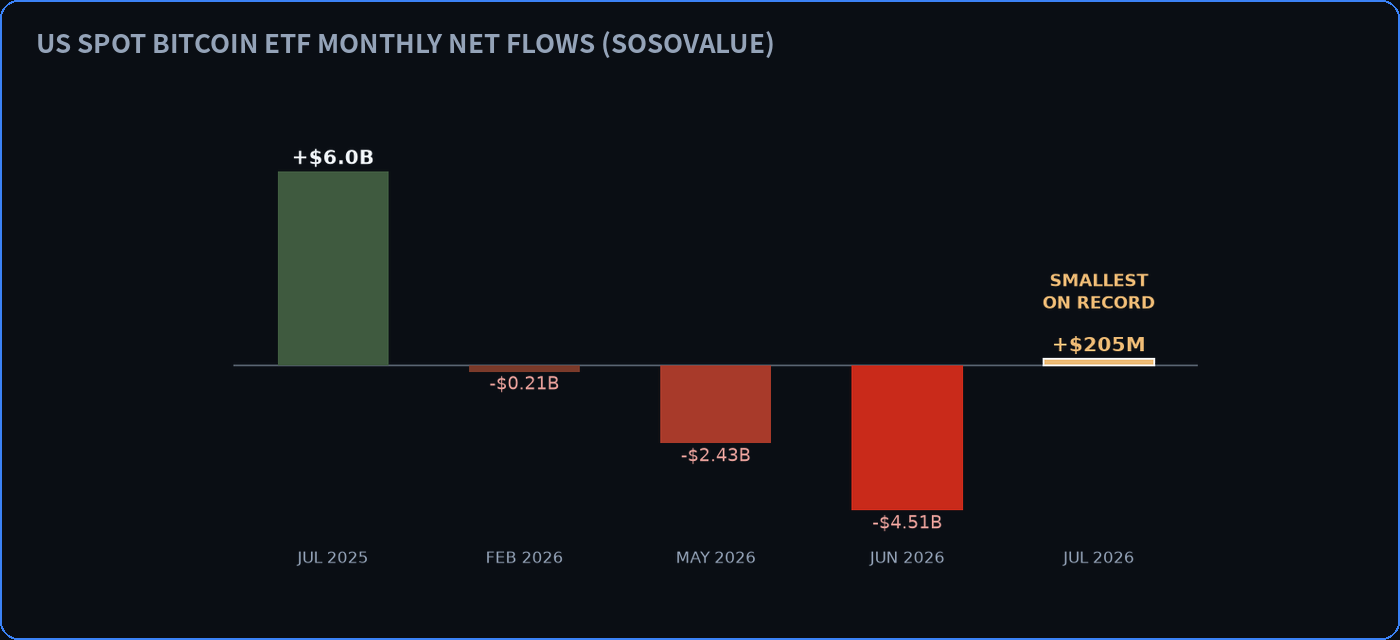
According to SoSoValue data cited by FinanceFeeds on July 30, US spot Bitcoin ETFs had taken in approximately $205 million net for July, specifically $204.67 million, with two trading days left in the month. That was the smallest monthly inflow total since the products launched in January 2024.
The context makes the number look even thinner. May 2026 saw a net outflow of $2.43 billion. June followed with a $4.51 billion outflow, the worst single month on record. Between early May and late June, the ETF complex bled more than $8.2 billion across eight straight weeks of outflows. July did not reverse that damage. It barely interrupted it.
The comparison with prior periods is stark. July 2025 alone attracted more than $6 billion. February 2026 recorded a $206 million outflow, which means July 2026’s positive $204.67 million print was smaller in absolute magnitude than February’s negative month. A plus sign made the month look constructive. The scale said otherwise.
This is where the daily headlines distorted the signal. In mid-July, a seven-session inflow streak pulled in nearly $1 billion, and Bitcoin ETFs logged three consecutive positive weeks for the first time since early May. Those facts were true. They were also incomplete. July 23 saw $225 million leave. July 24 saw another $240 million leave. Two red sessions consumed much of what the streak had built.
Streak accounting is seductive because it turns market structure into narrative. Seven green days sound like renewed sponsorship. Three positive weeks sound like a durable institutional bid. Net flow accounting tells a different story. The ETF complex was not rebuilding its 2025 impulse. It was stabilizing after a violent withdrawal of capital.
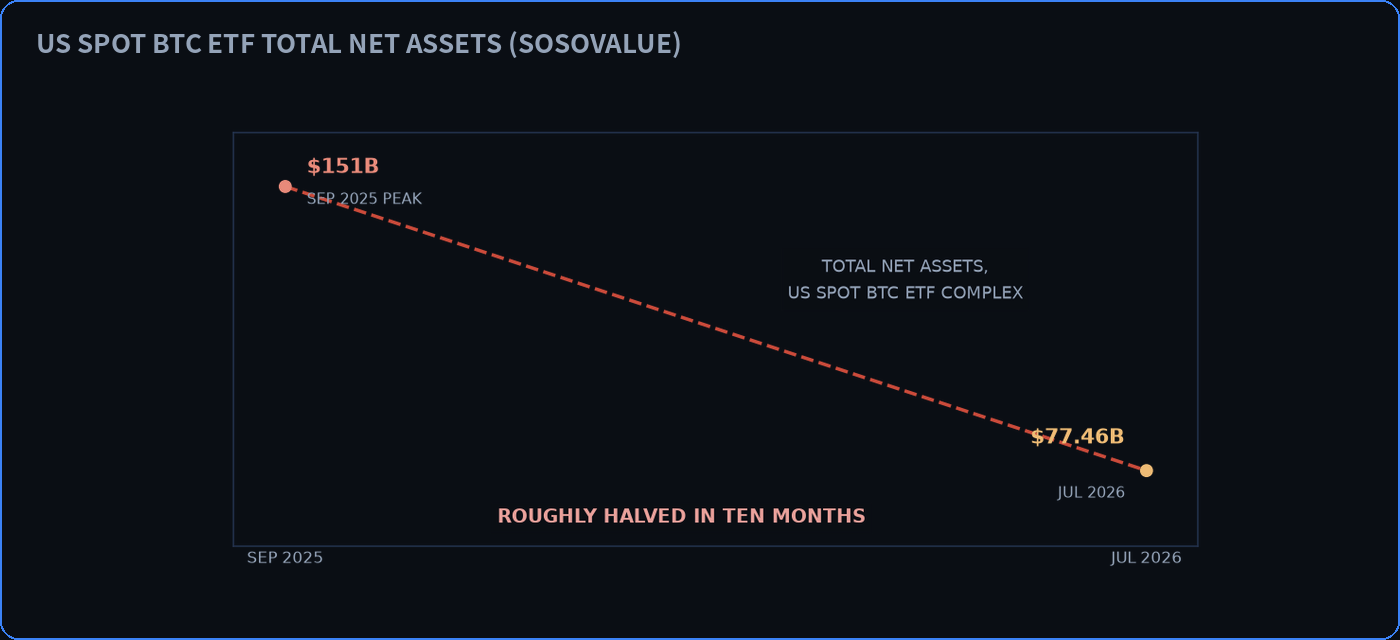
The asset base confirms the scale of the reset. Total net assets across the spot Bitcoin ETF complex stood at $77.46 billion as of July 29, down from a peak above $150 billion, approximately $151 billion, in September 2025. The complex has shed roughly half its value in ten months. That figure reflects both price and flow effects, but the message is hard to miss. The ETF channel is no longer acting like the dominant source of marginal demand that investors grew used to during the earlier phase of the cycle.
The divergence is the signal
The surprise is not that ETF demand collapsed. The surprise is that Bitcoin did not.
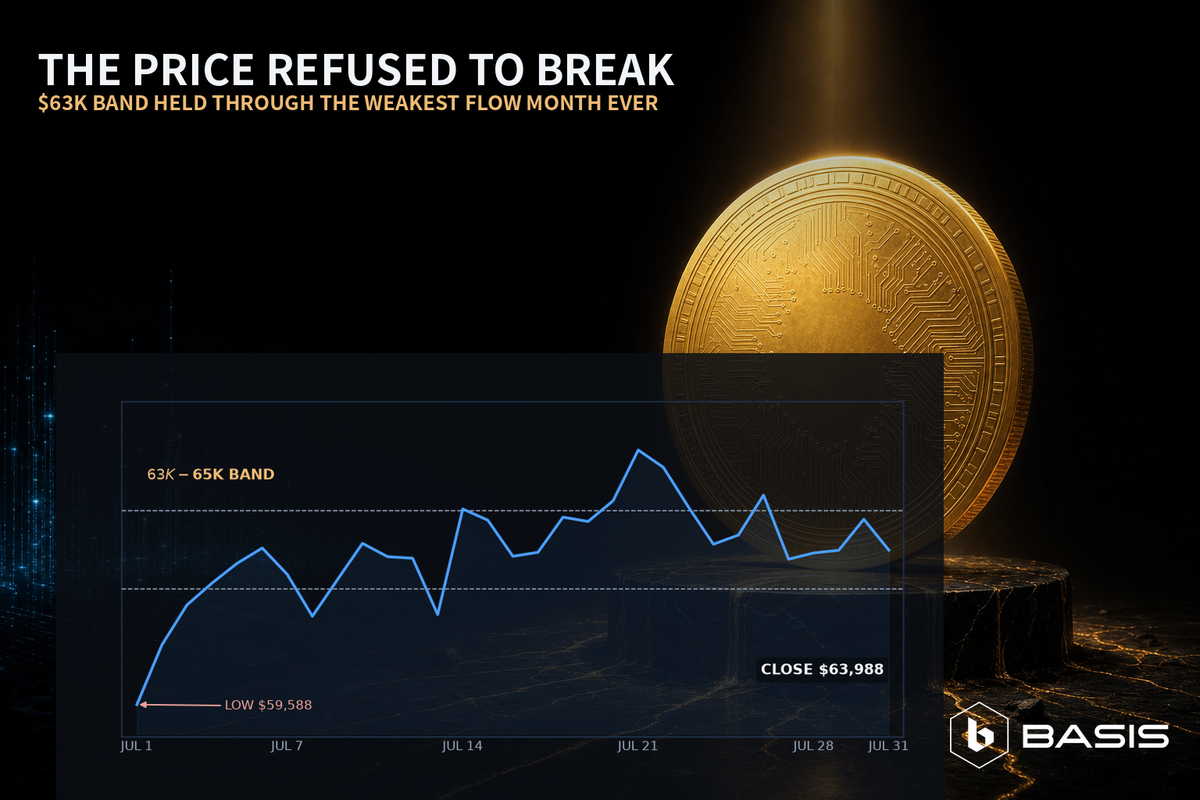
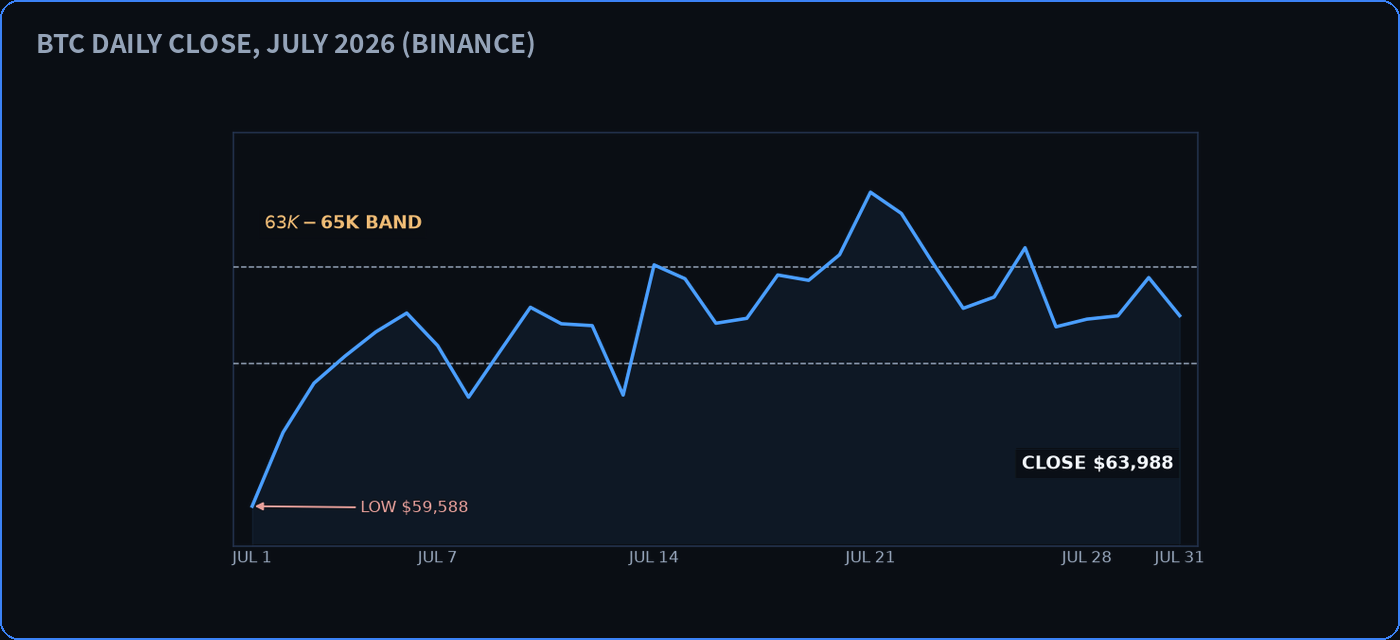
On Binance data for July 31, BTC traded around $63,944. The July path was contained rather than disorderly: $61,560 on July 2, $66,114 on July 22, and $63,944 on July 31. The 30-day range ran from a high of $66,956 to a low of $59,588. Through late July, despite the weakest inflow month on record, price held a $63,000 to $65,000 band.
That is the market’s key message. The most visible institutional flow channel faded, sentiment deteriorated, and yet spot did not crack.
The first explanation is seller exhaustion. The $8.2 billion exodus between early May and late June did the work normally associated with capitulation, but it did it over weeks rather than in a single violent candle. By the time July arrived, many holders who were sensitive to ETF headlines, performance anxiety, or liquidity needs had already sold. July’s weak inflow number was therefore not a fresh shock to a complacent market. It was the residue of a purge already absorbed.
The second explanation is the absence of leverage froth. Binance futures data from July 29 to July 31 showed BTC perpetual funding rates in a narrow, mildly positive band between +0.0037% and +0.0100% per eight hours. That is not a crowded long market paying punitive funding to stay levered. It is also not a market dominated by capitulation shorts. Positioning was neutral.
Neutral funding matters because forced selling usually needs fuel. If longs are crowded and funding is stretched, a modest spot decline can trigger liquidations and reflexive de-risking. If shorts are crowded and funding is deeply negative, a squeeze can distort price in the other direction. July showed neither condition. The market lacked speculative oxygen. That made it harder for ETF weakness to become a liquidation event.
The third explanation is holder rotation. The evidence is not an on-chain ownership map. It is the market’s behavior under stress. When a complex loses more than $8.2 billion over eight weeks, records its weakest inflow month, and still sees BTC hold the late-July band, the marginal holder has changed. Flow-tourists have been reduced. Conviction hands, balance-sheet buyers, strategic allocators, and holders who are not taking their cue from ETF streak headlines appear to be a larger share of the remaining base.
Sentiment data reinforces the point. The Alternative.me Fear and Greed Index printed 25, Extreme Fear, on July 31 after a week between 26 and 30, Fear. Depressed sentiment with stable price is not bullish by itself. It does show that fear is no longer automatically translating into incremental supply.
That is the divergence investors should study. ETF flows collapsed. Price did not. The floor held because the selling had already happened, leverage was not primed for forced liquidation, and the ownership base had become less sensitive to the same headlines that drove the previous phase.
The Fed split, gold bid, and failed digital-gold trade
The macro setting should have favored Bitcoin’s store-of-value narrative. It did not.
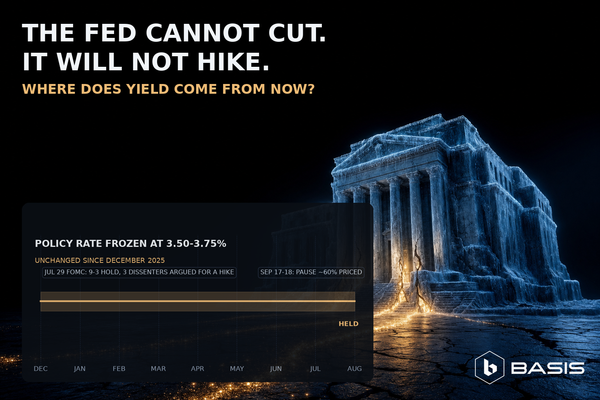
On July 29, the Federal Reserve voted 9-3 to hold the federal funds rate at 3.5% to 3.75%. The dissents were hawkish. Beth Hammack of Cleveland, Neel Kashkari of Minneapolis, and Lorie Logan of Dallas all favored a 25 basis point hike. Inflation has remained above the 2% target for more than five years. It was the first time since September 2016 that three policymakers dissented with a unified directional view.
Chairman Kevin Warsh has argued for giving markets fewer signals about the next move. BMO’s Ian Lyngen described the result as “a Committee with vocal hawks.” That is not a clean easing setup. It is a policy regime defined by uncertainty, limited guidance, and unresolved inflation credibility.
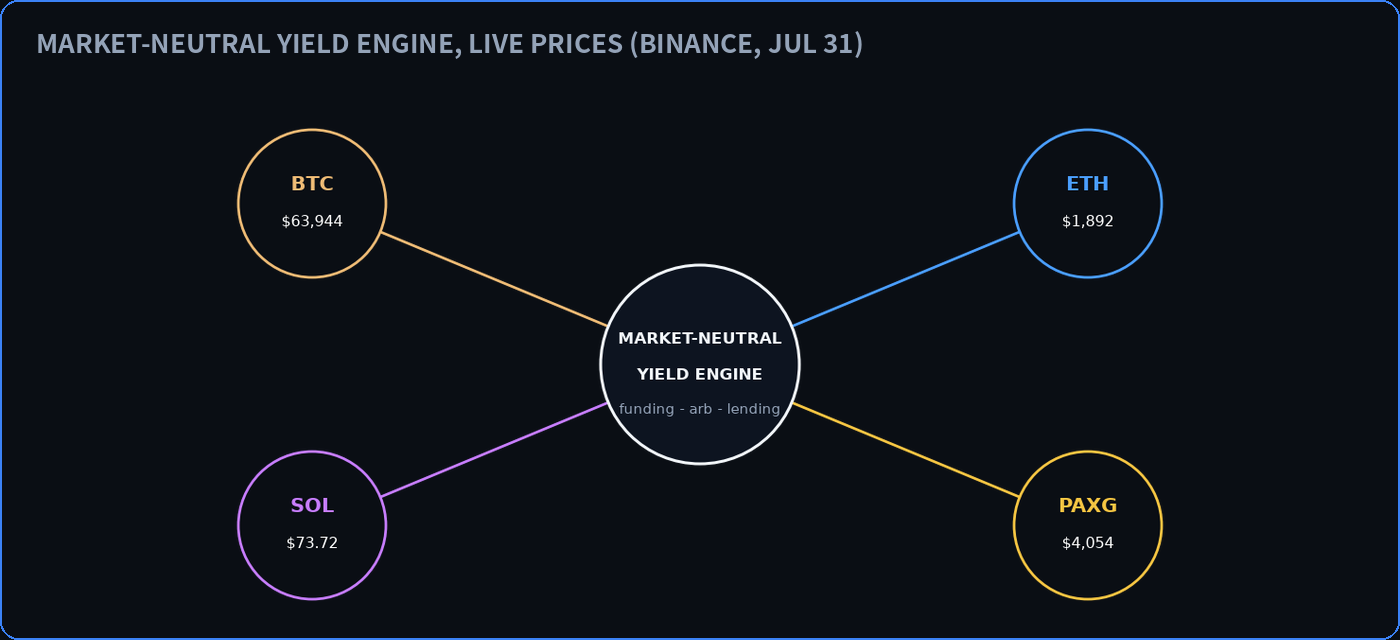
Gold absorbed that uncertainty. Spot gold traded near $4,134 on July 31, in record territory, lifted by Middle East conflict and Fed uncertainty. PAXG traded around $4,054. Bitcoin did not behave the same way. BTC ranged. ETH traded near $1,892, SOL near $73.72, and the ETH/BTC ratio sat around 0.0296. The broader crypto complex was not showing a strong internal risk-on impulse either.
By the standard that matters in a live macro shock, realized market behavior, the digital gold narrative failed this cycle.
That does not mean Bitcoin has no monetary thesis. It means allocators cannot assume that macro fear automatically turns into a Bitcoin bid. In this cycle, gold remained the reflexive hedge. Bitcoin traded more like a scarce, volatile, liquidity-sensitive asset whose marginal demand still depends on flows, positioning, and risk appetite.
For institutional portfolios, that distinction is not academic. If Bitcoin does not reliably behave like gold when the Fed is divided, inflation remains above target, geopolitical risk is elevated, and gold itself is making records, then Bitcoin’s role has to be priced differently. It may still offer convexity, liquidity, portability, and long-duration monetary optionality. But this cycle showed that those qualities did not translate into the classic safe-haven trade.
That failure also helps explain why price stability in July should not be mistaken for renewed macro sponsorship. Bitcoin held its floor without winning the gold trade. The support came from market structure, not from a dominant haven bid.
The opportunity cost of idle Bitcoin
A flat Bitcoin is not costless in a 3.5% to 3.75% policy-rate world.
During zero-rate periods, waiting could feel almost free. Investors could sit through months of range-bound price action because the explicit hurdle rate was low. That regime is gone. With the Fed holding rates and offering fewer signals about the next move, capital has an alternative. Short-duration, policy-linked return exists. Cash has value. Balance sheet has value.
For Bitcoin holders, the opportunity cost is not theoretical. If BTC is held idle while price ranges, the investor is accepting volatility without receiving cash flow from the asset itself. That trade can still be rational for long-term holders, but it is no longer frictionless. The higher the policy-rate floor, the more a non-yielding asset has to justify its place through appreciation, portfolio utility, or productive use.
This is where volatility changes category. For an unhedged holder, volatility is usually the price paid for upside. For a market-neutral operator, volatility can be inventory. Funding premia, exchange dislocations, borrow demand, and liquidity imbalances appear because the market is fragmented and constantly repricing risk. They do not require a new ETF inflow wave. They require movement, disagreement, and infrastructure capable of converting microstructure into return without taking outright directional exposure.
The July setup is almost designed for that distinction. ETF demand was weak. sentiment was poor. The Fed was divided. Gold took the haven bid. Bitcoin did not break, but it did not trend cleanly either. In that regime, waiting for the next narrative leg carries a measurable cost. Making the asset productive becomes the more disciplined question.
How market-neutral yield is manufactured
Market-neutral yield is often described too loosely. The mechanics matter.
Funding rate capture in perpetual futures begins with the structure of the contract. Perpetual futures do not expire, so exchanges use funding payments to keep the perp price anchored to the spot index. When the perp trades rich and funding is positive, longs pay shorts. A market-neutral strategy can hold spot BTC and short an equivalent notional amount of BTC perpetual futures. If BTC rises, the spot leg gains while the short futures leg loses. If BTC falls, the spot leg loses while the short futures leg gains. The intended exposure is not long or short Bitcoin. It is long the funding payment, adjusted for fees, slippage, collateral costs, and hedge maintenance.
The July funding data illustrates the difference between carry and speculation. Funding between +0.0037% and +0.0100% per eight hours is mildly positive, not euphoric. A hedged book does not need euphoric funding. It needs repeatable funding, disciplined sizing, and the ability to reduce exposure when conditions deteriorate. The relevant variable is not whether ETF flows return. It is whether the futures market is paying for short-side balance sheet and whether the hedge can be maintained through price moves.
The details are where traders separate real carry from disguised beta. Hedge ratios must be monitored as price changes. Collateral has to be managed so the futures leg cannot be forced out during volatility. Venue exposure has to be capped. Funding can flip negative. Fees can consume small spreads. Mark prices, index prices, and liquidation engines can behave differently under stress. A funding-capture strategy is market-neutral only if the operational stack keeps it neutral.
Cross-exchange arbitrage is different but rests on the same principle. Crypto does not trade on a single consolidated order book. The same asset can trade at different prices across venues because liquidity, inventory, latency, and local demand differ. An arbitrageur buys where the asset is cheaper and sells where it is richer in matched size. Directional exposure is minimized because the profit source is the spread between venues, not the future price of Bitcoin.
That sounds simple until execution risk enters. If one leg fills and the other does not, the strategy becomes inventory. If withdrawals slow, capital can be trapped. If a venue throttles during volatility, the apparent spread may not be monetizable. If latency is poor, the quote is gone before the order arrives. The edge is not seeing a price difference. Everyone can see it. The edge is capturing it with minimal legging risk and exiting when market conditions no longer support the trade.
Blue-chip DeFi lending adds a third source. The return is borrower-paid interest, not price appreciation. Assets are supplied into lending markets where borrowers pay to access liquidity. The quality of the return depends on collateral standards, utilization, liquidation mechanics, oracle reliability, smart contract risk, and the depth of liquidity when positions need to be unwound. Properly structured, the strategy is not a bet that BTC, ETH, SOL, or tokenized gold rises. It is a bet that secured borrow demand exists and can be serviced within defined risk limits.
These mechanisms do not require ETF inflows, narrative strength, or a bullish price direction. ETF flows can influence volatility and positioning, but they are not the revenue engine. The revenue engine is market imbalance. Perp longs paying shorts, venues pricing the same asset differently, and borrowers paying for liquidity can all exist in flat, fearful, or confused markets.
That is why market-neutral yield sits outside the ETF story. A directional investor needs fresh demand. A market-neutral allocator needs tradable dislocation, disciplined hedging, and risk controls that survive the period when dislocation becomes stress.


Risk architecture now matters more than yield promises
In this regime, the first question is not how much yield a strategy advertises. The first question is what happens when the strategy is wrong, crowded, delayed, or cut off from liquidity.
Funding can reverse. Spreads can vanish. A profitable arbitrage can become a partial fill. A lending market can face liquidation pressure. A price oracle can lag. A futures venue can widen margin requirements. A calm range can become a gap before a human risk committee has met. Carry strategies fail when they assume the market will remain polite.
That is why deterministic controls matter. A deterministic control does not wait for a portfolio manager to decide whether a drawdown is temporary. It follows rules set in advance. If exposure leaves its permitted band, reduce it. If hedge integrity breaks, stop adding risk. If venue conditions degrade, halt execution. If collateral buffers narrow, de-risk. If principal-loss risk reaches a defined threshold, stop strategy activity.
The point is not to remove risk. That is impossible. The point is to prevent a low-volatility income strategy from becoming a hidden directional bet at the exact moment liquidity becomes expensive. In market-neutral crypto, risk control is not a back-office function. It is the product.
This is also why operational facts deserve more weight than yield language. Latency, throughput, auditability, information security, service management, legal identity, and research process all affect whether a strategy can behave as described under pressure. A slow hedge is not a hedge. A circuit breaker that depends on debate is not a circuit breaker. A yield source that cannot be decomposed is not research, it is faith.
The precedent is the fearful middle
The useful historical comparison is not a price chart with a neat bottom circled after the fact. It is the long middle that came after the damage.
After the 2018 crypto drawdown, investors lived through a period when confidence was scarce and liquidity had to be earned back slowly. After the 2022 drawdown, the same pattern repeated in a different form. Trust did not return all at once. Balance sheets were repaired. Counterparty risk was repriced. Survivors were not simply the investors who guessed the bottom. They were the investors who preserved optionality, controlled risk, and found ways to make idle assets productive while sentiment remained poor.
Gold offers a parallel outside crypto. After its post-2013 break, gold spent years in a difficult middle. The investors who endured that period most effectively were not waiting for a public all-clear. They treated the asset as balance sheet, collateral, or a component of a broader carry and risk framework. The asset did not need constant narrative validation to remain useful.
This is not a forecast that Bitcoin will follow either path. The analogy is behavioral and operational. Markets rarely move from panic to clarity in a straight line. They spend time in ranges where headlines conflict, macro signals disagree, and investors grow impatient. Those are the periods when opportunity cost compounds quietly.
The flat, fearful middle rewards a different discipline. Not prediction. Not slogan. Productive ownership.
The productive response
July’s ETF print showed that the old marginal buyer has weakened. It did not show that Bitcoin has lost its floor. That is the central message. The market has stopped depending on ETF flows alone to absorb supply.
For holders, the response is not to force a price view. The stronger response is to ask whether Bitcoin, ETH, SOL, and tokenized gold exposure can be held in a way that harvests volatility, funding, lending demand, and fragmented liquidity without requiring a directional call.
That is where BASIS fits the analysis. BASIS is a market-neutral staking platform supporting BTC, ETH, SOL, and PAXG. Its yield sources are funding rate capture in perpetual futures markets, cross-exchange arbitrage, and blue-chip DeFi lending. Rewards accrue in real time as the same stToken, including stBTC, stETH, stSOL, and stPAXG.
The relevant detail is not a promised yield number. It is the structure. BASIS uses the BSCB, or Sentinel Circuit Breaker, to halt strategy activity automatically when a defined principal-loss risk threshold is reached. Its BHLE execution stack is specified at sub-50 microsecond latency and more than 100,000 operations per second. Its research partner is Base58 Labs, a UK registered company with Companies House No. 17094713. BASIS also lists ISO/IEC 27001:2022 certification, Certificate No. SC62455E, and ISO/IEC 20000-1:2018, both verifiable via IAF CertSearch. Its LEI is 254900IX2F2KCWNSSS64.
None of that makes market-neutral yield risk-free. It changes the underwriting question. Instead of asking whether ETF inflows will return, whether Bitcoin will reclaim the digital-gold bid, or whether the Fed will deliver a clean signal, the holder can ask whether idle assets are being deployed through transparent, hedged, risk-controlled mechanisms.
That is the productive response to this market. The ETF bid has faded. Gold owns the haven narrative for now. The Fed is divided. Sentiment is fearful. Bitcoin is still standing.
In a regime like this, the edge is not waiting for the tape to resolve every argument. The edge is keeping the asset productive while the market argues.