The Fed Could Not Cut. So the Treasury Blinked. Bitcoin Touched $70,000.

The Fed Could Not Cut. So the Treasury Blinked. Bitcoin Touched $70,000.
On Tuesday, August 18, the 30-year Treasury yield touched 5.337%, its highest level since 2007. By Wednesday, Washington had moved.
Not the Federal Reserve. The Treasury.
On August 19, the US Treasury announced it will at least double the maximum size of its liquidity-support buybacks of longer-dated Treasury securities, from $2 billion to at least $4 billion per operation, beginning September 9, 2026. The operations will cover the 10-to-20-year and 20-to-30-year sectors and run through November 4, when the next Quarterly Refunding is scheduled.
The reaction was immediate. The 30-year yield reversed to about 5.19%, roughly 15 basis points off the peak, while the 10-year yield eased to about 4.649%. The Dow added about 230 points after the news. The S&P 500 had already hit new all-time highs the prior week.
Then crypto caught fire.
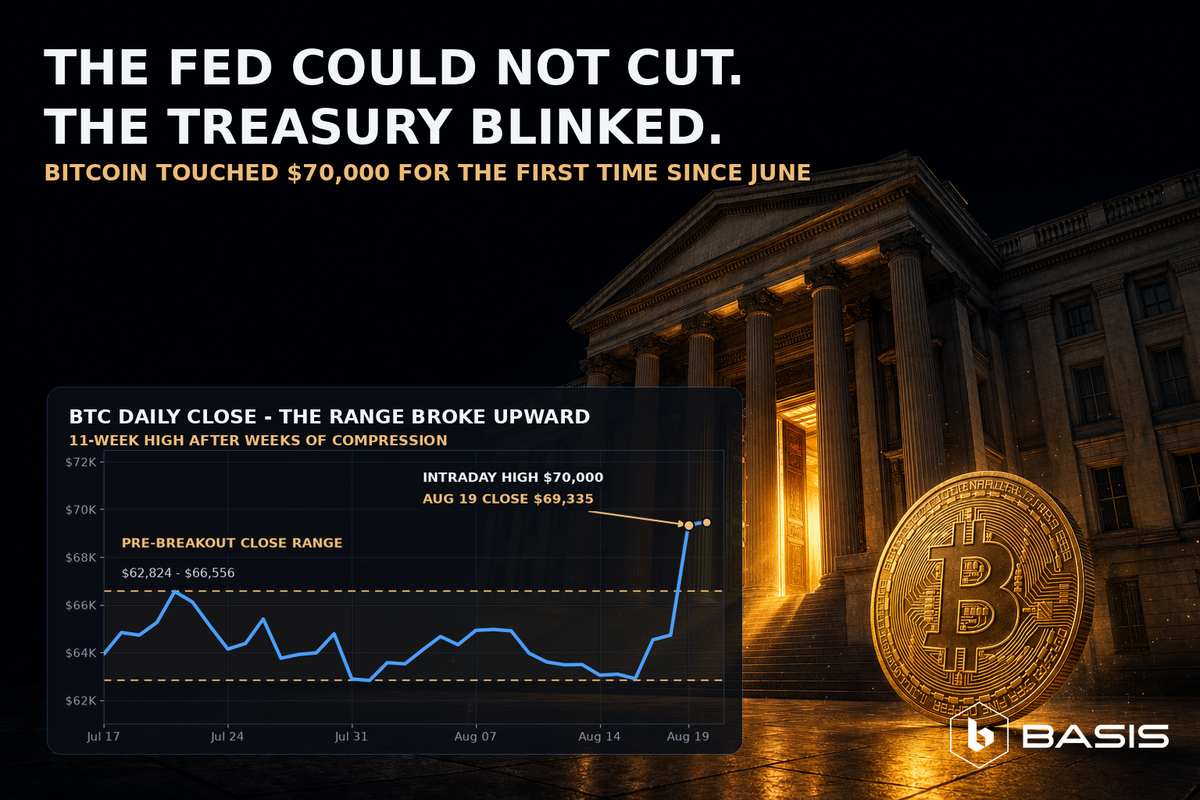
Bitcoin had spent weeks trapped between roughly $61,500 and $65,000. On August 19, it spiked to $69,749 on Bitstamp, about 6% on the day, its highest since June 2 and an 11-week high. It briefly touched $70,000 on Binance. As of August 20, BTC trades near $69,281, up 7.65% over 24 hours.
The move was broader than Bitcoin. ETH surged about 17.65% over 24 hours to about $2,251, breaking $2,000 for the first time this summer. SOL rose about 9.66% to $84.47. PAXG, tokenized gold, rose about 2.88% to $4,473.83. Gold and Bitcoin rallied on the same headline.
That detail matters. This was not a crypto-only squeeze looking for a macro story after the fact. It was a rates shock, a fiscal credibility signal, an ETF demand story and a leverage unwind, all arriving in the same narrow window.
The long bond forced the question
The long end of the Treasury curve has become the market’s most unforgiving scoreboard. Total US national debt is approaching $40 trillion. The Kobeissi Letter noted that interest payments reached $1.4 trillion over the past 12 months, roughly triple the 2020 level, and cited Bank of America data projecting $1.7 trillion by November 2028 if rates remain stable.
Those numbers change the meaning of a 30-year yield above 5%. The issue is not only the level of rates. It is the interaction between debt service, issuance, term premium and liquidity.
A government that must refinance and fund large deficits needs buyers across the curve. When the long end backs up, investors begin demanding more compensation for inflation risk, fiscal uncertainty, supply risk and mark-to-market volatility. Dealers require balance sheet to warehouse bonds. Asset managers demand concession. Older, less liquid bonds can trade with heavier liquidity premia. The more yields rise, the more the market asks whether the next auction clears cleanly, which can push yields higher again.
That is how a yield level becomes a policy problem.
The 5.337% print on the 30-year was not a magic number. It was a pressure point. At that level, the bond market was no longer merely discounting sticky inflation. It was testing how much pain the fiscal authority would tolerate in the long end before intervening in market plumbing.
On August 19, the answer arrived.
The Fed trap did not disappear. It moved to the Treasury desk
BASIS Insights wrote on August 13 that the Fed was trapped. That framework now looks like the correct starting point for the August 19 move.
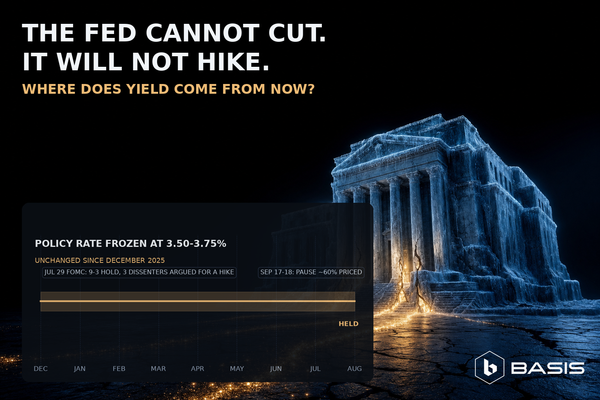
The Fed held the federal funds rate at 3.50% to 3.75% on July 29, 2026, in a 9-3 vote. The minutes, released August 19, showed three dissenters, Beth Hammack, Neel Kashkari and Lorie Logan, wanted a 25 basis point hike immediately. Many other officials said a hike may still be needed if inflation does not cool.
The inflation data gave them cover. The Fed’s preferred inflation gauge ran at 3.7% in June, far above the 2% target. July CPI, reported August 12, was 3.4% year over year, with core CPI at 2.5%. Analysts estimate core PCE remains somewhat above 3%.
The labor data argued the other way. The July payrolls report, released August 7, showed a loss of 23,000 jobs against a forecast gain of 80,000.
Then there is the supply shock. The US and Iran have been in an active armed conflict since late February 2026. The Strait of Hormuz, which carried roughly one fifth of global oil supply shipments before the conflict, remains largely closed. Fed officials warned in the minutes that the Middle East conflict could keep supply costs high. They also debated AI, with some officials arguing the AI boom is pushing prices up and others expecting it to cut costs.
Chair Kevin Warsh added another layer by floating the idea of cutting the number of FOMC meetings from eight to six per year. No decision has been made. The idea alone moved markets because fewer meetings compress volatility into fewer, larger catalysts. The next FOMC meeting is September 15-16, and before the Treasury announcement markets had shifted toward pricing a possible September hike.
That is the trap. The Fed cannot easily cut with core PCE estimated above 3%. It is unwilling to hike aggressively into a labor market that just printed negative payrolls. It also cannot ignore energy supply risk.
So the institution that sets rates stayed boxed in. The institution that issues debt moved first.
Why the buyback signal mattered more than the dollars
Treasury buybacks are often misunderstood because the word “buyback” sounds like easing. This was not Federal Reserve quantitative easing.
The Treasury is repurchasing older, less liquid bonds with cash the government already holds. No new bank reserves are created. The operation is designed to support market liquidity in specific maturity sectors, not to expand the central bank balance sheet. It can improve the functioning of off-the-run securities and rearrange the maturity profile of outstanding debt, but it does not carry the same monetary mechanics as QE.
Peter Boockvar of One Point BFG Wealth Partners, quoted by CNBC, put it cleanly: this is not a debt paydown, it is a rearrangement of the maturity schedule.
The Treasury’s official framing was technical. It said the increase reflects “consistent strong sponsorship” and “the significant volume of high-quality offers” it routinely receives in longer-dated operations. Nick Timiraos of the Wall Street Journal flagged the announcement on X on August 19, helping bring the market’s attention to what might otherwise have looked like a plumbing adjustment.
The dollar size was small relative to net issuance. That is why the announcement should not be treated as a mechanical liquidity flood. The market reaction was about the signal.
The Treasury was effectively telling investors that stress in the 10-to-20-year and 20-to-30-year sectors had its attention. The timing sharpened the message. The announcement arrived immediately after the 30-year yield touched 5.337%, the highest level since 2007. The long bond had tested the fiscal pain threshold, and the Treasury responded near the weekly peak.
Jim Bianco of Bianco Research captured the psychology when he wrote that he had been saying bond traders can stop panicking when the Fed starts panicking, and that he should have said bond traders can stop panicking when Scott Bessent starts panicking. Scott Bessent is Treasury Secretary.
That is why Bitcoin moved. Not because $4 billion per operation changes the supply-demand balance of the Treasury market by itself. It moved because the market inferred that a line had been drawn near 5.3% on the 30-year.
Bitcoin’s rally was macro first, then mechanical
Bitcoin remains sensitive to liquidity conditions, real-rate expectations and policy credibility. It is not a Treasury bond. It does not discount cash flows. Yet in stress moments it often trades like a high-beta expression of whether the market believes policymakers will tolerate tightening financial conditions.
On August 19, the message from rates was that the long end had pushed far enough to force a response. That repriced risk assets quickly. It also repriced scarce, non-sovereign assets. The simultaneous rally in PAXG showed the bid was not simply for crypto beta. Investors bought both tokenized gold and Bitcoin on the same policy signal.
Then market structure did the rest.
Weeks of low volatility inside the $61,500 to $65,000 range had encouraged leveraged traders to position for the range to continue. A quiet range breeds short-volatility behavior. Traders sell rallies, lean short near the top of the range and use leverage because the tape appears controlled.
The break through $66,000 changed the payoff. Short positions in perpetual futures and other derivatives began hitting liquidation thresholds. Exchanges close those shorts by buying back exposure, and that forced buying pushes the market higher, which triggers the next layer of liquidations.
Derivatives data show roughly $1.1 billion to $1.3 billion in crypto short positions were liquidated as the squeeze accelerated. Coinglass data showed about $1.48 billion in total liquidations, the majority shorts, within a single 60-minute window. One outlet described it as the biggest short liquidation volume on record. About $196 million in shorts were liquidated as Bitcoin broke $69,000.
That is the classic anatomy of a squeeze. The macro headline provides the spark, the rangebound setup provides the fuel, and forced buying turns a breakout into a vertical move.
The funding data kept the move from looking purely speculative at the time of writing. Perpetual funding rates on Binance sat at about 0.01% for BTC and ETH after the move, positive but not overheated. If funding had exploded, the rally would have looked more like late longs chasing. Instead, the market showed a mix of short covering, spot demand and renewed institutional sponsorship.
Sentiment flipped just as violently. The Fear and Greed Index printed 62, Greed, on August 20 after spending roughly two weeks between 27 and 46, Fear, including readings of 27 to 34 in the prior week. The same market that looked unwilling to take risk suddenly looked worried about missing risk.
ETF demand gave the squeeze real sponsorship
The strongest argument against dismissing the rally as only a liquidation event is the ETF tape.
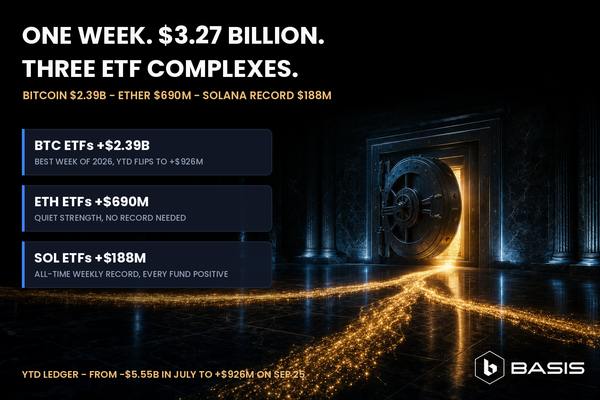
US spot Bitcoin ETFs took in $297.6 million on Monday August 17 and $189.3 million on Tuesday August 18. IBIT led with $143.6 million, while Fidelity’s FBTC added $23.9 million. The two-day total was $487 million, more than half of August’s net inflows so far. August net inflows stand at about $951 million, approaching $1 billion.
That came after three sessions of net outflows from August 12 to August 14 totaling about $250 million. In other words, ETF demand had already turned before the Treasury headline.
Cumulative net inflows into US spot Bitcoin ETFs stand at about $52.28 billion, with total net assets near $79.3 billion. That matters because the ETF complex had looked tired only weeks ago. BASIS Insights noted on July 31 that July 2026 was the smallest monthly inflow on record at about $204.67 million, after May saw a $2.43 billion outflow and June a record $4.51 billion outflow. The ETF complex’s assets bottomed at $77.46 billion on July 29, down from a peak near $151 billion in September 2025.
August is now on pace to reverse the July pattern.
BlackRock commentary this week said Bitcoin has largely purged the froth that preceded its roughly 50% drop from $126,000, the all-time high. Metaplanet also expanded its Bitcoin treasury strategy to the US with a 2,100 BTC Nasdaq-listed play on August 18.
That does not make the rally self-sustaining by definition. It does mean the squeeze met real demand. A forced bid from liquidations is temporary. ETF inflows are stickier, slower-moving and easier for institutional allocators to benchmark. When both arrive together, price can travel farther than leverage positioning alone would imply.
The liquidity warning that keeps the tape honest
There is a counterweight, and it is not cosmetic.
Bitfinex noted that stablecoin liquidity on exchanges has decreased by about $14 billion since May, and argued that until stablecoin supply turns, the rally stays unfunded. CryptoQuant’s Stablecoin Supply Ratio rose from 9.82 to 11.69 since June 30, its highest reading of 2026, meaning stablecoin dry powder has been leaving exchanges.
That is the condition to watch.
ETF inflows and stablecoin liquidity measure different pipes. ETF flows capture regulated brokerage demand for spot Bitcoin exposure. Stablecoin balances capture crypto-native purchasing power sitting on exchanges, ready to chase, defend or rotate. A rally can be sparked by ETF sponsorship and amplified by liquidations, but a durable crypto-wide advance typically needs exchange liquidity to return.
This is especially relevant for altcoins and for intraday market depth. If stablecoin balances keep falling, breakouts can remain sharp but uneven. Liquidity can appear abundant on the way up and vanish on the first reversal. That does not negate the August 19 move. It defines the next test.
Ethereum’s parallel message: access is turning into yield
ETH’s 17.65% move was larger than Bitcoin’s, and the reason was not only beta. Ethereum has its own institutional yield story.
Spot Ether ETFs added $71.5 million on August 18, bringing August net inflows to about $345 million. More broadly, issuers are no longer competing only on access. They are competing on staking economics.
Fidelity filed with the SEC on August 11 to allow its FETH Ethereum ETF to stake up to 100% of its holdings under normal conditions, retaining 85% of staking rewards for the fund with 15% going to staking fees, and planning quarterly cash distributions. FETH had about $2.13 billion in cumulative net inflows as of August 11. Grayscale became the first US issuer to enable staking in spot crypto ETPs in October 2025, and BlackRock launched its iShares Staked Ethereum Trust ETF, ETHB, in February 2026. Bitmine reportedly holds nearly 5% of Ethereum’s supply.
The message is clear. Institutional crypto is moving from exposure to exposure plus yield.
That shift helps explain why ETH broke $2,000 for the first time this summer on the same macro impulse that lifted Bitcoin. Investors are not only repricing Ethereum as a high-beta asset. They are repricing the value of assets that can be put to work.
The investor lesson from fear, greed and Washington timing
For roughly two weeks, the Fear and Greed Index sat between 27 and 46. In the prior week it printed readings of 27 to 34. Investors who waited in cash for “clarity” may have earned cash interest, but they earned none of the event. Then a 7.65% Bitcoin day and a 17.65% ETH day arrived without warning.
The investors who were positioned earned the breakout. The investors who needed confirmation got a headline, a gap and worse entry conditions.
That is not an argument for chasing every rally. It is an argument against building a portfolio around the hope that policy will become legible in advance. Washington does not send invitations before it changes the reaction function. The Fed minutes were hawkish. The labor data were weak. Inflation was still too high. The long bond was breaking. Then the Treasury acted.
Timing Washington is not a strategy.
The deeper lesson is that the entire episode, a trapped Fed, a Treasury intervention and a liquidation cascade, is exactly the kind of policy-driven volatility that punishes directional timing and rewards structure. Directional exposure can work spectacularly when the headline breaks your way. It can also sit dormant for weeks, shake out weak hands, then reprice before a committee has even met.
Yield-seeking investors should separate two questions. The first is whether they want exposure to BTC, ETH, SOL or tokenized gold. The second is whether that exposure should sit idle while markets churn, or whether the portfolio can harvest the frictions created by that churn.
Why market-neutral yield belongs in the portfolio conversation
This is where market-neutral yield becomes relevant. Not because it forecasts the next Treasury headline. Because it does not need to.
BASIS is a market-neutral yield platform operated by BASIS DIGITAL INFRASTRUCTURE LTD, a Seychelles IBC, founded February 4, 2026. Its LEI is 254900IX2F2KCWNSSS64. Its research partner is Base58 Labs, a UK registered company, Companies House No. 17094713. BASIS raised a $35 million Pre-Series A in September 2025.
The platform supports BTC, ETH, SOL and PAXG. Users receive staking tokens, stBTC, stETH, stSOL and stPAXG, that accrue rewards in real time. All four underlying assets rallied in this news cycle, including PAXG with gold.


The yield logic is structural rather than directional.
The first source is funding rate capture from the perpetual futures basis. Perpetual futures need a funding mechanism to keep their price anchored near spot. When leveraged traders want long exposure, they may pay shorts through positive funding. When shorts dominate, funding can flip. A market-neutral strategy can pair spot or spot-like exposure with an offsetting perpetual position when the funding relationship is attractive. The yield comes from the willingness of leveraged traders to pay for synthetic exposure, not from a bet that Bitcoin, Ether or Solana must rise.
The second source is cross-exchange arbitrage. Crypto trades across fragmented venues, and forced flows do not hit every order book at the same instant. During liquidation cascades, one venue can gap above or below another as local liquidity is consumed. An arbitrage engine buys where the asset is cheaper and sells where it is richer, seeking to capture convergence while keeping net market exposure hedged. Violent breakouts like August 19 are exactly the type of event that can widen cross-venue price gaps.
The third source is blue-chip DeFi lending. Borrowers pay for liquidity because they need collateral, leverage, inventory or working capital. Demand for borrowing often rises during volatility events, when traders need to defend positions, move collateral or finance arbitrage. A lending strategy earns from that borrowing demand rather than from outright price direction, provided collateral, protocol and liquidity risks are managed.
None of these mechanisms is magic. Market-neutral does not mean risk-free. Basis relationships can invert. Venues can gap. Lending markets can reprice. Execution quality matters.
That is why the infrastructure layer is central. BASIS runs the BASIS High-Performance Liquidity Engine, or BHLE, with sub-50 microsecond latency and more than 100,000 operations per second. In markets where liquidation cascades and exchange dislocations can last seconds or less, speed is not cosmetic. It determines whether a theoretical spread can be captured before it disappears.
The safety design is also mechanical. BSCB, the Sentinel Circuit Breaker, automatically halts all strategy activity if principal loss risk reaches 0.001%. DMM, Defensive Maintenance Mode, is a controlled pause state for investigation, balance verification and stable resumption. BASIS holds ISO/IEC 27001:2022, Certificate No. SC62455E, and ISO/IEC 20000-1:2018 certifications, both active and verifiable on IAF CertSearch.
After an August 2026 infrastructure update, staking activation after confirmation now typically completes in 10 to 60 minutes, down from about 2 hours. Optional Booster lock tiers increase reward rates by +10% for 14 days, +20% for 30 days, +50% for 90 days and +100% for 180 days. These are reward-rate boosts on the position, not APY promises. The platform also uses a privacy-preserving design with no KYC requirement.
For investors who already hold BTC, ETH, SOL or PAXG, the question after August 19 is not whether volatility will return. It already did. The question is whether the portfolio earns only when direction is right, or whether it also earns from the funding flips, venue dislocations and lending demand that volatility creates.
The next dates are known. The reaction function is not.
The Treasury buyback operations begin September 9. The next FOMC meeting is September 15-16. The buyback schedule runs through November 4, when the next Quarterly Refunding is scheduled.
Those dates will matter. So will the 30-year yield, ETF inflows, stablecoin balances and the funding rate curve across perpetual markets.
But August 19 already answered the larger question. The Fed could not cut. The Treasury did not cut either, but it moved where it could. It used the buyback desk to signal that long-end stress had gone far enough. Bitcoin, Ether, Solana and tokenized gold responded because policy-driven volatility had repriced the cost of waiting.
The range between fear and greed remains the market’s only constant. Yield should not have to wait for Washington to blink.