Hong Kong's Solana ETF Fee War Still Misses The Yield Question


A Second Solana Wrapper Lands on HKEX
This morning in Hong Kong, Pando Finance turned Solana ETF access from a one-product market into a fee contest. Its spot Solana ETF began trading on HKEX on Oct 13, 2026 under ticker 02831, also quoted as 2831.HK, with an annual management fee of 0.6%. ChinaAMC's incumbent spot Solana ETF, ticker 03460, charges 0.99%. The advertised cut is real. It gives allocators a cheaper listed route to SOL and forces the first competitive price marker into what had been a single-provider corner of the market.
The narrower measure is less dramatic but still material. Pando estimates its ongoing charges ratio, or OCR, at 1.6%, against 1.99% for ChinaAMC. The management-fee gap is 0.39 percentage point. The OCR gap is also 0.39 percentage point, which matters because the headline fee is only part of the cost an investor actually bears. The base currency is USD, the shares trade in HKD, the indicative issue price is HK$7.80 to HK$8.00, and the minimum lot of 100 shares puts the cash ticket near HK$800 before transaction charges.
The HKEX listing circular is the document that turns that exposure into operating infrastructure. It fixes where the underlying SOL is held, how trading and custody connect, how settlement is handled, and how creation and redemption mechanics are meant to work when units are issued or cancelled. For a listed fund, that plumbing is not secondary. Market makers and brokers need to know what asset backs the shares, which counterparties touch it, and how fund units can be created or redeemed against the portfolio without improvising custody or settlement steps.
That is why the HashKey mandate matters. The fund tracks the CME CF Solana Dollar Index, using the Asia-Pacific closing price variant. Trading and custody run through HashKey Exchange and HashKey Custody Services, with an HKEX circular dated Oct 9 confirming the custody and settlement arrangements. In Hong Kong's regulated virtual-asset regime, that means the listed product is not asking institutions to accept an informal custody chain. It gives compliance teams a named exchange and custodian inside the local framework.
The index choice also has a purpose. A CME CF Solana Dollar Index Asia-Pacific closing variant aligns valuation with the region's trading day, rather than forcing a Hong Kong-listed product to explain every NAV move through a distant closing window. That does not remove crypto's continuous trading problem, but it reduces the mismatch between the exchange board investors use and the reference point the fund uses to strike value.
There is also a currency layer. The fund's base currency is USD, while the shares trade in HKD. A Hong Kong investor sees a HKD share price, but the asset exposure is still SOL priced through a USD-base reference. That means the wrapper contains both the crypto exposure and the translation between the fund's base currency and the trading board currency. The HKD quote makes access local. It does not turn the underlying exposure into a pure SOL-HKD position. This is Pando's third spot virtual-asset product, after its existing Bitcoin and Ethereum ETFs.
The Wrapper Race Is Global
The context is bigger than a Hong Kong ticker. The city was the first Asian market to launch spot BTC and ETH ETFs in 2024, and that template created the approval path this product now uses. The earlier funds established the pattern: regulated trading access, named custody arrangements, index-based valuation, exchange settlement, and disclosure that lets a volatile token sit inside a listed securities wrapper. Once BTC and ETH had cleared that route, the 2025 approval of the first spot Solana ETF in Asia made SOL the next test of the same architecture.
That first-approval episode also showed how wrapper launches get marketed. The then-cited $400 analyst target around the 2025 Solana approval was less useful as a forecast than as a lesson in packaging. A listing can reduce access friction and invite flow-based narratives, but it does not change the protocol's economics, the token's drawdown risk, or the income decision embedded in the wrapper. The launch story and the asset design are different questions.
According to Solana's official account on Oct 12, cited by CoinGape, global spot Solana ETFs now hold approximately $1.9 billion in net assets, with $1.61 billion of cumulative net inflows, and recent weekly inflows surpassed $1.3 billion. Those figures say SOL wrappers have moved beyond experiment. They do not say the category has the depth, liquidity, or distribution power of the Bitcoin ETF complex.
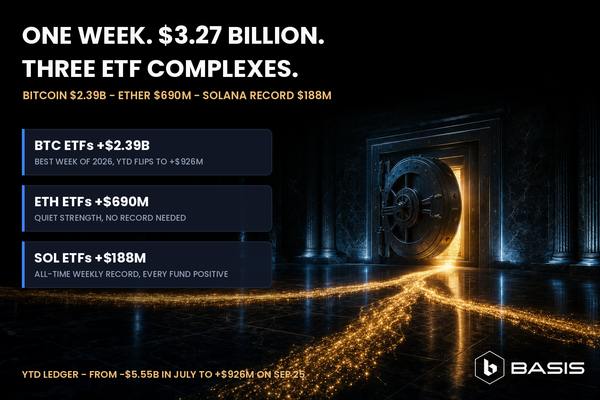
This publication's Sept 29, 2026 Bitcoin ETF analysis, "The ETF Ledger Turns Positive While Bitcoin Refuses the Easy Story," showed how powerful the wrapper story can become when flows turn, with US spot Bitcoin ETFs adding $134.5 million on Friday Sept 25, sealing a $2.39 billion week, the strongest of 2026, and flipping year-to-date net flows positive at about +$926 million. The comparison is useful because the cited Bitcoin week alone was larger than the approximately $1.9 billion global spot Solana ETF asset figure. Solana inherits the flow logic of the ETF format, but it has not inherited Bitcoin's scale.
It also adds something Bitcoin never had in the same way, a native staking yield that these Hong Kong wrappers do not collect. That makes the fee contest more complicated than it first appears. Morgan Stanley's move to launch Ethereum and Solana ETFs in the US shows that product expansion and fee pressure are no longer confined to Asia. Once US distribution enters the same asset class, the fee argument travels through broker platforms, advisory channels, and institutional model portfolios. Hong Kong's second Solana ETF is therefore not only a local challenger to ChinaAMC. It is part of a global compression in wrapper economics.
A Drawdown, Not A Victory Lap
Pando is not launching into a rally. SOL trades at $108.35, down 3.39% over 24 hours, after a 24-hour range between $101.69 and $113.10. The two-week structure is less forgiving. SOL closed around $120 to $121 in early October, including $121.60 on Oct 4, then fell to $109.62 on Oct 8 and $105.76 on Oct 12 before stabilizing near today's level. That puts the token down roughly 8% to 11% over the period, depending on the starting point.
The broader tape is cooler rather than broken. BTC trades at $83,592, down 0.23% over 24 hours and still within its recent $81,700 to $86,500 band. The Fear and Greed index is at 57, down from 73 on Oct 6, while perpetual funding across BTC, ETH, and SOL sits near neutral, roughly -0.002% to +0.007%. The SOL dip looks like a leverage flush in thin conditions, not a structural break. Still, the launch is being tested in a drawdown, not in a clean upswing.
A leverage flush is mechanical before it is narrative. In perpetual futures and margin markets, a price move can push leveraged positions through liquidation thresholds. Forced selling then meets order books that may already be shallow because market makers have reduced size or widened quotes. Each liquidation can push the price into the next threshold, creating a cascade. In thin conditions, the same notional flow moves the market more because there is less resting liquidity to absorb it.
Neutral funding after the drop is part of the evidence. If the market had immediately rebuilt aggressive long exposure, funding would usually lean positive. If traders had crowded into short exposure, funding would usually lean negative. A near-neutral range after the move says the speculative excess was rinsed rather than clearly repositioned. The Fear and Greed slide from 73 to 57 tells a similar story. Positioning cooled, but it did not reach fear. That is a reset, not capitulation.
This is precisely the tape in which the income question stops being academic. In a strong upswing, beta can hide almost every implementation choice. In a drawdown, fund costs, tracking, liquidity, and forgone yield become part of the allocation result. The difference between owning SOL exposure through an unstaked listed claim and owning SOL through a structure that captures network income is no longer a footnote when the spot price is falling.


The Design Choice That Matters
Read the fund design and the deeper issue appears quickly. Pando's ETF holds actual SOL. It does not stake, use leverage, or deploy derivatives. Up to 3% of the portfolio may sit in cash to cover operating expenses and redemptions. The same structural point applies to Hong Kong's listed SOL wrapper market as a whole, since these products are built around unstaked spot exposure. That design may be rational. It is also costly.
The first constraint is redemption liquidity. An exchange-listed spot fund needs to meet creations and redemptions through a process that market makers can hedge and settlement agents can administer. Staked SOL is not the same operational asset as freely transferable SOL. If a fund has delegated tokens and then faces redemption demand, staking unbonding timelines can create a mismatch between the liquidity promised by the listed wrapper and the liquidity of the staked position. The cash sleeve helps with operating needs, but it does not turn a staked asset into an instantly redeemable asset.
The next constraint is index purity. Pando tracks the CME CF Solana Dollar Index, using the Asia-Pacific closing price variant. That benchmark is a spot price reference, not a staking-return benchmark. Adding staking rewards would introduce a second return stream that depends on validator performance, reward timing, and fund-level treatment of income. The fund would no longer be a clean listed instrument for SOL spot exposure. It would be a spot instrument plus an active income policy.
Custody rules create another boundary. Holding SOL in custody is one function. Delegating that SOL to validators is an active network decision. The custodian or manager would need procedures for delegation, monitoring, reward receipt, and operational failures. That is not impossible, but it is a different risk profile from holding unstaked tokens against a spot index.
Validator selection is also a liability. Someone must choose where the stake goes, how concentrated the delegation can be, what commission levels are acceptable, how performance is monitored, and what happens if a validator underperforms. Liquid staking routes add their own token, smart-contract, and liquidity considerations. Those choices may be reasonable for a native holder. They are harder to bury inside a passive listed wrapper.
Then there is income treatment. Staking rewards inside a listed fund raise questions about whether rewards are reinvested, distributed, accrued into NAV, offset against expenses, or treated differently for accounting and tax purposes. Those questions are not excuses. They are real constraints for a product designed to trade like a security on HKEX. But the cost is plain. The fund is designed to deliver SOL price exposure minus fund costs, not SOL price exposure plus network income.
The Yield Sitting Outside The ETF
The yield being omitted is not trivial. On Oct 13, DeFiLlama's yield data showed JitoSOL, the Jito liquid staking token, at 4.74% APY on $1.14 billion of TVL. BNSOL, Binance staked SOL, showed 4.49% on $1.12 billion. JupSOL stood at 5.47% on $0.56 billion, dSOL at 5.03% on $0.30 billion, MSOL at 5.23% on $0.25 billion, and PSOL at 5.69% on $0.17 billion. Across those routes, major Solana liquid staking tokens currently pay roughly 4.5% to 5.7% APY on billions of dollars of total value locked.
At the network level, the yield starts with issuance paid to stakers for participating in Solana's security model. Validators and delegators are compensated for keeping stake committed to consensus. On top of that, transaction priority fees and MEV captured by liquid staking routes such as Jito can feed into the return received by token holders, depending on the route and its design. Liquid staking turns that delegated position into a transferable token, but it also adds a token-market layer between the investor and native SOL.
The spread between JitoSOL at 4.74% and PSOL at 5.69% is not random. It can reflect validator selection, commission policy, MEV capture and sharing, route-level fees, token liquidity, integrations, and the market's comfort with each liquid staking token. It is also notable that JitoSOL's $1.14 billion of TVL is far larger than PSOL's $0.17 billion, while PSOL's stated APY is 0.95 percentage point higher. A higher displayed yield may compensate for lower liquidity, different route risk, or a different reward mix. The yield number is therefore not separable from the instrument used to earn it.
Those numbers should not be read as a risk-free replacement for an ETF. Staking income pays for network security participation and brings exposure to validator performance, smart-contract implementation, liquidity, and token-market basis risk in liquid staking tokens. But they do show what the ETF format omits. Pando's lower fee is meaningful when compared with ChinaAMC's 0.99% management fee and 1.99% expense ratio. Yet the larger comparison is not only 0.6% against 0.99%, or 1.6% against 1.99%.
For a Pando buyer, the explicit ongoing charge is roughly 1.6%. The native yield not collected is roughly 4.5% to 5.7%. Expressed as the opportunity-cost stack, that is 1.6% paid plus 4.5% to 5.7% forgone, or 6.1 to 7.3 percentage points of annualized items before considering price movement, custody choice, liquidity, tax, or execution. That is not an implied investor return figure. It is the size of the income and cost question created by choosing an unstaked wrapper over a native-income route.
The funds are competing over basis points while leaving percentage points outside the product. That does not make the wrapper irrational. It means the wrapper solves one problem and refuses another.
What Wrappers Still Do Well
None of this makes wrappers pointless. For many institutions, a regulated brokerage account, familiar settlement, no self-custody burden, and suitability for mandates that cannot touch native crypto custody are the entire point. Mandate language often distinguishes between listed securities and direct ownership of tokens. An allocation that is impossible in native form may be permitted if it arrives as an exchange-listed fund with ordinary custody, brokerage reporting, audit trails, and board-approved service providers.
That operational layer has value. Self-custody at scale is not just a wallet decision. It requires key management, signer controls, internal approvals, reconciliation, incident response, counterparty reviews, chain monitoring, and procedures for forks, airdrops, staking, and failed transfers. For an institution whose systems are built around listed securities, an ETF can be cheaper to govern even when its fee is visible and its opportunity cost is real.
Fee wars are also good for investors. A 0.6% management fee against 0.99% is real competition, and Asia's regulated SOL access is deepening. The OCR gap is narrower than the headline fee gap, and ongoing charges are only one part of implementation. Tracking difference, bid-ask spreads, and premium or discount to NAV may matter just as much for actual execution.
The historical pattern in ETF markets is that fee wars compress costs toward the floor once products become substitutable. The US Bitcoin ETF fee race is the recognizable precedent. Sponsors compete on headline fees, temporary waivers, trading liquidity, platform access, and brand. Over time, the wrapper becomes less a high-margin novelty and more a distribution utility. Morgan Stanley's US entry in Ethereum and Solana products points in the same direction for non-Bitcoin crypto exposure.
ETF inflows are also a constructive signal for SOL itself. If SOL appreciates, wrapper holders participate fully in that price move, less fund costs and implementation effects. The recent tape disciplines the other side of the argument as well. A 5% staking yield does not protect against a 10% drawdown, and the last two weeks made that concrete. Income matters, but it is not a shield against spot risk.
The Allocation Question
The investor lesson is narrower and more useful than a simple ETF-versus-native argument. An allocation committee should state the problem before choosing the instrument. If the problem is policy access to SOL through a regulated exchange-listed instrument, Hong Kong's second ETF is progress. If the problem is capturing income from the asset or from crypto market structure, an unstaked wrapper answers differently. It answers access with yes and income with zero.
That zero should be a conscious choice, not a default hidden inside convenience. Portfolio construction is not only about what asset is selected. It is also about what implementation path is used, what income is accepted or forgone, what liquidity is required, what reporting format is needed, and what operational risks the investor is willing to own. A listed SOL ETF may be the right answer for a mandate-constrained sleeve. It may be the wrong answer for a sleeve whose purpose is to harvest crypto-native income.
For investors who decide the second problem is the one to solve, BASIS belongs in the comparison as market-structure infrastructure rather than as another ETF wrapper. Founded on Feb 4, 2026 as a Seychelles IBC, with LEI 254900IX2F2KCWNSSS64, the platform added ETH, SOL, and PAXG support on March 10, 2026. It had a $35 million Pre-Series A in September 2025, with Base58 Labs as research partner. Yield generation runs on funding-rate capture, cross-exchange spread execution, and DeFi lending, and no directional exposure is required for those strategies to function.
The mechanism is different from staking and different from a listed ETF. Funding-rate capture seeks to harvest the imbalance created when leveraged perpetual traders pay to maintain exposure, a spread that can widen when volatility expands and demand for leverage becomes less balanced. Cross-exchange spread execution can also find wider harvestable gaps during volatility because liquidity pulls back, order books become thinner, and prices across venues separate before arbitrage closes them. DeFi lending is collateral-based, so the income mechanism comes from borrower demand and collateral rules rather than from the market rising.
The BHLE matching engine is specified at sub-50 microsecond latency and more than 100,000 operations per second. That speed matters most when spreads are temporary and execution quality determines whether a theoretical gap is actually captured. BSCB, the Sentinel Circuit Breaker, automatically halts all strategy activity if principal loss risk reaches 0.001%, while DMM provides a controlled pause state for investigation, balance verification, and stable resumption. Those controls are the discipline layer, not a return promise.
ISO/IEC 27001:2022 certificate SC62455E and ISO/IEC 20000-1:2018 are verifiable on IAF CertSearch, with SOC alignment ID 6489580/COC/SC and GDPR alignment ID 6489581/COC/SC. Its lock boosters of 14 days +10%, 30 days +20%, 90 days +50%, and 180 days +100% are reward-rate boosts applied to a variable base rate, not APY promises. That does not make it interchangeable with an exchange-listed ETF. It makes it a different answer to the access-versus-income split.
What To Watch Next
The first observable test is simple. Watch first-day volume on 2831.HK and the fund's premium or discount to NAV. Volume will show whether the lower fee is enough to generate real secondary-market demand, not just a cleaner comparison table. A premium would suggest demand is outrunning creation or market-making capacity, or that currency and timing frictions are affecting execution. A discount would point to weak demand, selling pressure, or imperfect arbitrage. Tight trading around NAV with meaningful volume would be the healthiest signal for the wrapper's plumbing.
Watch whether ChinaAMC responds on price. A fee response would confirm that the incumbent sees Pando's lower management fee as a flow threat rather than a headline nuisance. No response would suggest ChinaAMC believes liquidity, track record, distribution, or brand can defend assets despite the 0.39 percentage point management-fee gap and the 0.39 percentage point OCR gap.
Then watch the macro tape, with US CPI due on Oct 14 and the FOMC meeting on Oct 28. Those dates frame the next stretch of risk pricing because crypto remains sensitive to liquidity, rates, and the dollar even when the story is written in ETF language. They do not imply any forecast. They simply define the calendar against which a new SOL wrapper must trade.
The fee war will have a winner. The more interesting competition is the one the wrappers are not fighting.