The Fed Cannot Cut and Will Not Hike. Where Does Yield Come From Now?

The August policy trap
August 2026 has produced the kind of macro paradox that turns a normal rate cycle into a trap. Inflation is softening at the margin, and the labor market just printed a negative payrolls number, yet the most hawkish internal Fed debate in years is not cut versus hold. It is hold versus hike.
US CPI for July 2026 rose 3.4% year over year, down from 3.5% in June, reported August 12, 2026 by the Bureau of Labor Statistics. Core CPI rose 2.5% year over year, down from 2.6%. That sounds like progress. The composition was less comforting. The month over month easing in core was driven largely by a sharp drop in hotel prices that analysts consider unlikely to persist, and more categories of core goods saw price increases than in June. Technology prices jumped on AI demand. Gasoline prices fell in July, but global fuel prices rose again in August.
The Fed cannot cut because its preferred inflation gauge is still too high. Core PCE, the Fed's preferred measure, is estimated by analysts, Omair Sharif of Inflation Insights among them, to remain somewhat above 3%. A central bank with a 2% inflation objective cannot easily celebrate a core CPI print whose relief came from hotels, while core PCE remains above 3%, core goods diffusion worsens, technology prices rise on AI demand, and energy risk sits inside every forecast.
The energy risk is not theoretical. The United States and Iran have been in an active armed conflict since late February 2026. The Strait of Hormuz, which carried roughly one fifth of global oil supply shipments before the conflict, remains largely closed. That keeps an energy price tail risk alive inside every inflation forecast. Cutting rates into that distribution would loosen financial conditions while the inflation shock still has a live supply-side trigger.
But the Fed will not hike either. The July nonfarm payrolls report, released August 7, 2026, showed a loss of 23,000 jobs against a forecast gain of 80,000. The labor market is cracking at the same time inflation stays sticky. This is the policy trap. A hike would defend inflation credibility, but it would also tighten into a labor market that has already moved from slowing to outright job loss.
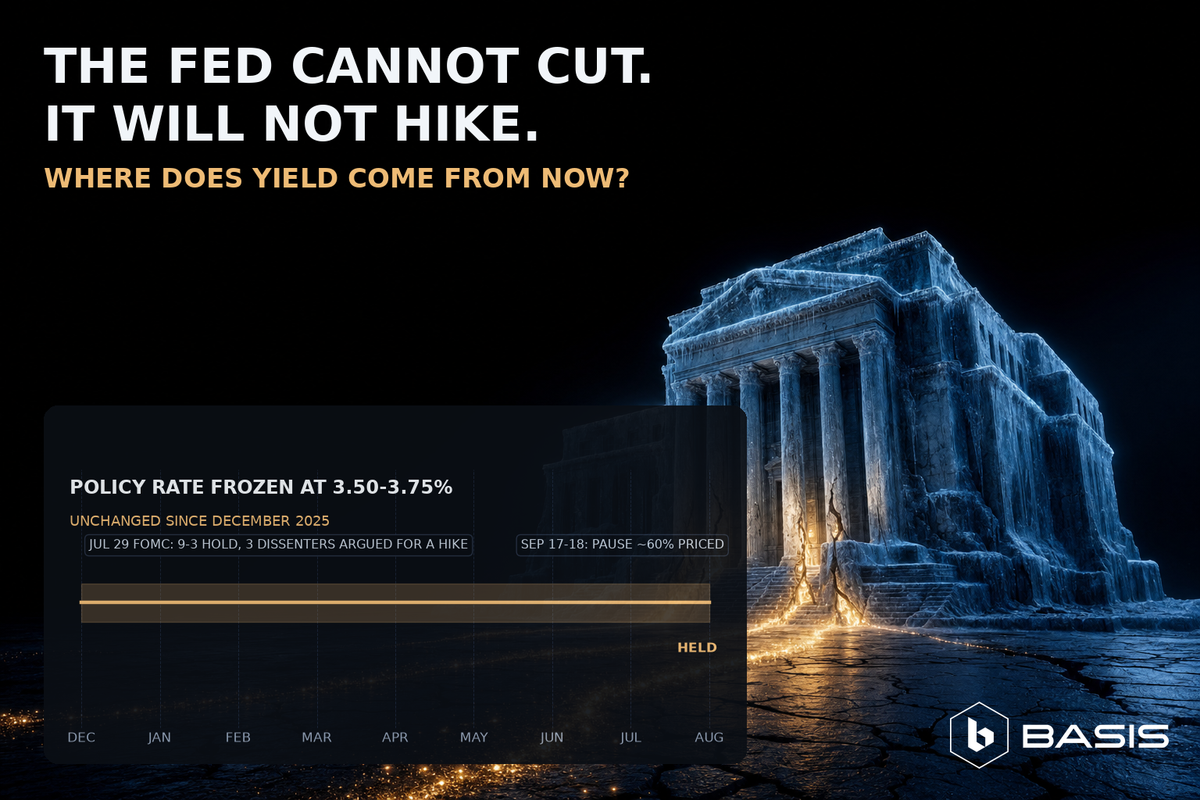
The FOMC voted 9-3 on July 29, 2026 to hold the federal funds rate at 3.50%-3.75%, where it has been since December 2025. The three dissenters, joined since by several regional Fed presidents, have argued for a rate hike, citing still-too-high inflation. New Fed Chairman Kevin Warsh has given almost no forward guidance. New York Fed President John Williams has said he expects inflation to keep easing as the effects of last year's tariff increases and the Middle East war fade, allowing the Fed to hold.
That is the center of gravity: hold. Not ease, because inflation credibility is still exposed. Not hike, because payrolls have cracked. After the August 12 CPI release, traders added to bets that the Fed leaves rates unchanged at the September 17-18 FOMC meeting. Market pricing put the odds of a September pause near 60%. The policy rate is frozen at 3.50%-3.75%, and the next catalyst keeps receding.
Cash is an option on a decision that keeps not arriving
A frozen Fed does not merely frustrate macro tourists. It reprices the opportunity set for institutional capital.
Every dollar in money market funds, T-bills, or bank deposits is capped at a yield the Fed itself has pinned. That yield is nominal. Against 3.4% CPI, a policy corridor of 3.50%-3.75% leaves only a thin pre-tax inflation cushion, roughly 0.10 to 0.35 percentage points before fees, deposit pass-through differences, and implementation frictions. For taxable investors, the arithmetic is harsher because tax is paid on nominal interest while inflation is not deductible. The after-tax real return can slip below zero.
Cash still has value. It gives optionality, liquidity, and psychological comfort. Those are real portfolio functions. But cash is no longer a high-conviction yield allocation if its return is pinned by a central bank that cannot cut and will not hike. Capital waiting for rate cuts is not patient, it is idle, and idleness now has a measurable opportunity cost.
This is the uncomfortable part of the front end. If the Fed cuts, cash yields fall. If the Fed holds, cash yields remain close to zero in real terms before tax and worse after it. If the Fed hikes, cash yields rise, but the reason would likely be inflation pressure severe enough to damage risk assets and real purchasing power. Cash has become an option on a Fed decision that keeps not arriving.
Directional exposure is stuck too
The alternative to idle cash is usually duration, equities, commodities, or crypto beta. But directional exposure is also trapped by timing.
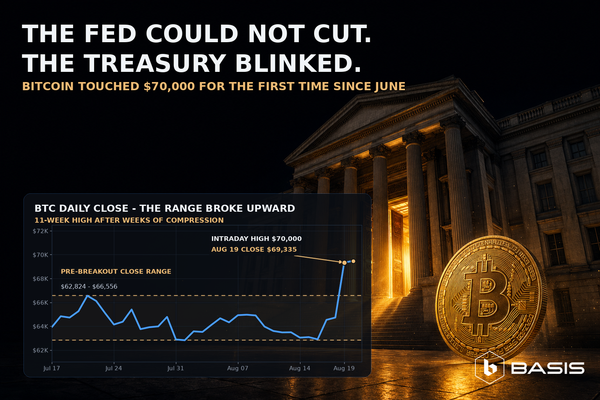
Bitcoin should have had a cleaner setup. US spot Bitcoin ETFs recorded $853.54 million in net inflows for the week ending August 7, 2026, the strongest week since mid-April and more than four times the entire month of July, which at roughly $205 million was the smallest inflow month on record. BlackRock's IBIT led and now manages over $47 billion. Grayscale's GBTC saw roughly neutral flows, meaning the multi-year outflow overhang is largely exhausted. Estimated ETF buying that week was about 13,100 BTC against roughly 3,150 BTC of new mining issuance, a demand to supply ratio above 4x. Whales purchased approximately $1.2 billion of BTC around the same window.
The supply backdrop also looks tight on paper. Post-halving mining issuance is 3.125 BTC per block. Exchange balances sit near four-year lows. Yet despite that demand, Bitcoin trades around $63,800 to $64,700, roughly 40% below the January 2025 all-time high of $108,000. Analysts are watching the $66,500 to $67,000 zone as the key resistance. Bitcoin trading volume has fallen to a three-year low, a condition several analysts describe as hibernation. Miners have sold roughly 28,000 BTC in 2026.
The market is absorbing demand, not repricing cleanly through it. That distinction matters. ETF buying at more than 4x weekly new issuance is powerful only if the marginal seller steps away. In this tape, enough supply has appeared to meet demand below resistance. Low exchange balances suggest less float on venues, but low volume also means less conviction, thinner price discovery, and a market that can sit dormant longer than a positioning model expects.
Sentiment confirms the freeze. The Crypto Fear and Greed Index has spent fourteen consecutive days between 25 and 31, in the Fear and Extreme Fear bands, printing 29 most recently. Institutions are buying through ETFs, whales are adding, miners are selling, volume is asleep, and fear remains pinned. That is not a clean trend. It is a stalemate.
Gold tells a similar story in a different language. Gold trades near $4,400 per ounce in mid-August 2026, still well below its January 2026 peak of $5,600. Central bank gold purchases continue but price has been rangebound for months. The classic crisis hedge has gone quiet even with an actual war closing the Strait of Hormuz. The lesson is not that gold is broken. The lesson is that a correct macro narrative does not automatically become a timely price move.
Being long is a bet on timing. Being flat is a bet against it. Neither is a yield strategy.
The third source of return is market structure
There is a third source of return that does not require a Fed pivot or a Bitcoin breakout. It comes from market structure itself.
This matters because markets do not stop functioning when prices stop trending. Leverage still has a cost. Liquidity is still fragmented. Borrowers still pay for balance sheet. Collateral still has financing value. Gold-backed tokens can still move through lending, repo-style, and basis structures even when gold itself is rangebound.
These return streams are not free money. They are payments for solving frictions that other participants create.
Perpetual funding is a peg mechanism
A dated futures contract has a natural convergence point. It expires. At settlement, the futures price and spot price must meet through delivery or cash settlement. A perpetual future has no expiry, so it needs another mechanism to prevent the contract from drifting too far away from spot. That mechanism is funding.
Most perpetual markets calculate a funding transfer based on the relationship between the perpetual contract's mark price and a spot index. When leveraged bullish positioning dominates, traders bid up long perpetual exposure because it offers synthetic spot exposure without paying the full cash price of the asset. The perpetual trades above spot. Funding turns positive. Longs pay shorts.
That payment is the control loop. It makes crowded long exposure more expensive and compensates traders willing to take the other side. A delta-neutral funding carry trade buys spot and shorts the perpetual on the same asset. If the asset rises, the spot leg gains while the short perpetual loses. If the asset falls, the spot leg loses while the short perpetual gains. The intended return is not the price move. It is the funding collected, net of costs and slippage, while the directional exposure is largely offset.
The mechanism also pushes the market back toward balance. The arbitrageur buying spot and shorting the perpetual adds demand to spot and supply to the expensive derivative. That pressure narrows the gap. Funding is not a decorative feature of crypto derivatives. It is the economic force that keeps a non-expiring leveraged instrument tied to the underlying asset.
Funding does not disappear just because spot price is rangebound or sentiment is fearful. Positioning never stops. Traders hedge, reduce risk, chase short-term moves, rebalance inventory, and rent leverage. Sometimes the long side pays. Sometimes the short side pays. The sign can flip, which is why execution and risk control matter. But the flow exists because perpetual markets continuously auction the cost of synthetic exposure.
Spatial arbitrage is the law of one price under stress
The same asset can trade at different prices on different venues because crypto markets are fragmented. There is no single consolidated order book for BTC, ETH, SOL, or PAXG. Each exchange has its own liquidity, participants, fees, inventory, custody constraints, withdrawal frictions, regional demand, and latency profile.
The phrase "same asset" holds in theory, but not always in operation. A BTC balance on one venue cannot instantly satisfy a buyer on another venue unless inventory is already positioned there. Moving assets takes time. Moving collateral takes time. Fiat rails, custody rules, and venue-specific risk all affect what a trader can actually do at the moment a spread appears.
That is why spatial spreads exist. If buyers lift offers aggressively on one exchange while another exchange remains cheaper, the price gap is an invitation. An arbitrageur sells where the asset is rich and buys where it is cheap. The trade compresses the spread and earns the difference after fees and slippage. The return comes from providing cross-venue balance sheet and speed.
Volatility compression does not eliminate spatial arbitrage. It changes its shape. Wide dislocations may become rarer, but smaller order-book imbalances can still open and close quickly. In a quiet market, spreads may be thinner and shorter-lived. They may depend more on queue position, routing, and pre-positioned inventory than on obvious headline dislocations. The edge moves from identifying the spread to capturing it before it disappears.
Overcollateralized lending is not unsecured credit
Blue-chip DeFi lending produces yield from borrowers who post more collateral than they receive. On established protocols such as Aave and Compound, borrowers do not receive funds because a lender believes their business model or income statement. They receive funds because collateral sits inside the protocol and can be liquidated if its value falls below required thresholds.
That makes the yield structurally different from unsecured credit risk. The lender is not primarily underwriting a borrower's willingness to repay. The protocol is enforcing a collateral rule. Borrowers pay because they want liquidity without selling assets, leverage against collateral, hedging capacity, or working capital for market activity. Rates respond to utilization. When demand to borrow rises relative to available supply, lending rates adjust.
This does not remove risk. It changes its location. The relevant risks become collateral volatility, liquidity during liquidation, oracle integrity, protocol execution, and smart contract behavior. But the economic source of yield is clear: borrowers are paying for overcollateralized access to liquidity.
Liquid staking on ETH and SOL adds another source. There, the flow comes from network reward mechanics tied to validation and participation rather than from borrower credit. In a market-neutral yield framework, these streams are useful because they are not simply a wager that ETH or SOL must rise next week.
Gold-backed tokens turn a dormant asset into financing flow
Gold is the classic non-yielding asset. A bar in a vault does not pay a coupon. That is part of its appeal, but it is also a portfolio limitation during long consolidations.
Gold-backed tokens such as PAXG change the operational form of the asset. The price of gold may be rangebound, but tokenized gold can move through lending, repo-style, and basis structures. A participant that needs PAXG for collateral, settlement, inventory, or positioning may pay to borrow it. A repo-style structure can transform gold-backed collateral into a financing transaction. A basis structure can capture differences between token pricing and associated financing markets while keeping outright price exposure controlled.
The yield does not come from predicting whether gold breaks out. It comes from the financing demand around an asset that otherwise sits dormant. That is the broader point. Each of these streams pays from market plumbing, not from Kevin Warsh's next sentence or Bitcoin's next candle.
Why this used to be institution-only
Market-structure yield has historically belonged to firms with infrastructure, not opinions. The reason is simple. The gross opportunity is often small, decays quickly, and punishes slow execution.
Funding flips sign. Spatial spreads open and close in milliseconds. Lending rates move as utilization changes. Collateral values move while the risk engine is still calculating exposure. A trade can be conceptually delta neutral and still fail through slippage, fees, stale marks, liquidation mechanics, inventory mismatch, or an inability to move collateral fast enough.
Execution quality is the entire game. Capturing a spatial spread requires price observation, order routing, inventory control, and settlement discipline across venues. Capturing funding requires knowing when the payment is worth the basis risk and when the sign has changed. Capturing lending yield requires collateral monitoring and protocol selection. Capturing PAXG financing flow requires understanding both the token and the gold-linked financing demand behind it.
That is why latency, throughput, and hard risk cutoffs matter. A slow arbitrage system does not harvest spreads. It donates them. A funding strategy without sign discipline does not earn carry. It becomes a hidden directional trade. A lending strategy without collateral discipline does not own yield. It owns liquidation risk.
BASIS and the infrastructure answer
This is where BASIS enters the argument naturally. The investment question is not whether cash is useless or whether Bitcoin and gold are unattractive. The question is whether capital can earn from the structure of markets while waiting for policy and price to unlock.
BASIS DIGITAL INFRASTRUCTURE LTD is a Seychelles IBC, LEI 254900IX2F2KCWNSSS64. Its research partner is Base58 Labs LTD, UK, Companies House No. 17094713. BASIS raised a $35 million Pre-Series A, fully allocated to strategic liquidity reserves. For this category, reserves matter because arbitrage, funding carry, and collateralized strategies require pre-positioned liquidity. They are not a guarantee of outcome.
BASIS supports BTC, ETH, SOL, and PAXG only. Users stake those assets and receive stBTC, stETH, stSOL, and stPAXG respectively, which accrue rewards in real time. The BIVB design maintains a strict 1:1 quantity peg between the deposited asset and the staked receipt token, so 1 BTC remains 1 stBTC.


The platform's four yield pipelines are all engineered for net delta near zero. Its spatial arbitrage pipeline, BQAE Core, captures price differences for the same asset across fragmented exchanges, executed by BHLE at sub-50 microsecond latency with capacity above 100,000 operations per second. Its delta-neutral funding carry pipeline pairs long spot with short perpetual futures on the same asset, collecting funding payments when leveraged bullish positioning pays shorts. Its blue-chip DeFi lending and liquid staking pipeline uses overcollateralized lending on established protocols such as Aave and Compound, plus liquid staking yield on ETH and SOL. Its PAXG real-world asset yield pipeline uses lending, repo-style, and basis structures built on gold-backed tokens.
The risk architecture is as relevant as the return architecture. BSCB, the Sentinel Circuit Breaker, automatically halts all strategy activity if modeled principal loss risk reaches 0.001%. DMM, Defensive Maintenance Mode, is a controlled pause state for investigation, balance verification, and stable resumption. These are engineered risk controls, not guarantees. BASIS never guarantees principal or returns, and rewards fluctuate with market conditions.
The operational stack is also documented. Certifications verifiable on IAF CertSearch include ISO/IEC 27001:2022, Certificate No. SC62455E, and ISO/IEC 20000-1:2018. The SOC attestation ID is 6489580/COC/SC. The GDPR compliance ID is 6489581/COC/SC. The fee schedule is 0% deposit fee, 0.05% withdrawal fee, 0.01% swap fee, and 20% performance fee on net profit only. Withdrawal processing is listed as BTC in 10 to 60 minutes, and ETH, SOL, and PAXG in 1 to 10 minutes. The Booster schedule rewards longer activation windows at 14 days +10%, 30 days +20%, 90 days +50%, and 180 days +100%. BASIS also has no KYC requirement by design, which protects user privacy.
None of that changes the basic truth of markets. Net delta near zero is a design objective, not immunity. Circuit breakers are controls, not promises. The analytical case is narrower: if the return source is funding, venue fragmentation, overcollateralized lending, liquid staking, and PAXG financing structure, then the portfolio is no longer waiting exclusively on the Fed or on a breakout candle.
The waiting itself can be productive
No yield is guaranteed anywhere. Not in cash, where nominal income can be consumed by inflation and tax. Not in directional crypto or gold, where a correct thesis can spend months trapped below resistance or below a prior peak. Not in market-structure strategies, where rewards fluctuate with market conditions and execution discipline determines what is actually captured.
Rates eventually move in some direction. Historically both Bitcoin and gold have recovered from deep drawdowns over multi-year horizons, though nobody can schedule the turn. A CIO can own those assets for strategic reasons and still admit that timing risk is real.
The point is narrower and stronger. While policy is frozen and price is frozen, structure keeps paying. Yield comes from the cost of leverage, the fragmentation of liquidity, the demand for collateralized borrowing, network reward mechanics, and financing demand around tokenized gold. The question in the title answers itself. The waiting itself can be productive.