September Was Supposed to Break Bitcoin. ETFs Pulled $3.8B in Three Weeks


A Calendar Curse Meets a Flow Ledger
Markets did not get their clean September script. The month carries a reputation as Bitcoin's worst seasonal stretch, and Monday September 1 opened with roughly $236.5 million in net outflows from US spot Bitcoin ETFs. By Thursday September 3, the ledger had flipped into $730.8 million of net inflows, the largest single-day haul since January 14, 2026. Whiplash is not conviction by itself, but it is useful when the numbers settle through custody accounts rather than social feeds.
Seasonality is a statistical regularity dressed up as destiny. It compresses different policy regimes, liquidity conditions, leverage cycles, tax calendars, fund positioning, and sentiment states into a calendar bucket, then invites traders to treat the average as a cause. A seasonal pattern can frame risk, but it cannot settle a single trade. It cannot show whether sellers are exhausted, whether allocators are adding exposure, or whether a listed product is issuing new shares against actual bitcoin. That is why September's first week matters. It moved the discussion from folklore to a flow ledger.
The Week in Settlement Data
SoSoValue, cited by CryptoBriefing, put the week ending September 5 at $986.9 million in net inflows. Farside Investors daily figures, reported by The Coin Republic, imply $986.7 million, a $200,000 discrepancy that does not change the trend. Tuesday September 2 had already reversed Monday with $101 million in inflows, then Thursday carried the week: BlackRock IBIT absorbed about $454 million, ARK 21Shares ARKB about $137.7 million, and Fidelity FBTC about $74.4 million, while VanEck and WisdomTree saw modest outflows. Friday September 4 cooled to $174.6 million of net inflows, with IBIT at $117.4 million and FBTC at $57.2 million.
The plumbing is the point. ETF shares trade in the secondary market, but net ETF flows are created in the primary market. Authorized participants bridge those layers. When demand for ETF shares pushes the listed product above its underlying value, an authorized participant can create new shares. The fund's balance sheet then increases its claim on actual bitcoin held at the custodian, and the new ETF shares move into the market. When selling pressure pushes the process the other way, shares can be redeemed and retired, with the underlying exposure reduced. That does not make ETF flows perfect, but it makes them harder evidence than exchange turnover or social sentiment. Turnover can recycle the same coins. Sentiment can be manufactured at low cost. Primary-market creations and redemptions require balance sheet, custody, compliance, and settlement.
The Three-Week Frame
Across the three weeks ending September 4-5, roughly $3.8 billion entered US spot Bitcoin ETFs, the strongest three-week inflow period of 2026. August 2026 had already delivered $3.5 billion in total Bitcoin ETF inflows, the strongest month since September 2025, which is why the early September tape matters more than the calendar joke. Cumulative net inflows since the January 2024 launch now stand at $55.6 billion. Total assets across all US spot Bitcoin ETFs stood at $101.3 billion after briefly touching $103.3 billion during the week, and BlackRock listed IBIT's net assets at $62.52 billion on September 4, about 62% of the sector. At prices near $80,000 and market capitalization near $1.6 trillion, the ETF complex collectively holds roughly 6% of that value.
The asset-base recovery has to be separated from the flow ledger. Net inflows measure subscriptions after redemptions. Total assets also move with price. Even so, the balance-sheet repair is large enough to matter. From the July trough of $77.46 billion to $101.3 billion, the complex rebuilt about $23.84 billion of assets, roughly 31 percent of the trough asset base, in about five weeks. That is fast against the size of the earlier hole, but it does not erase the hole. The sector had fallen from $151 billion to $77.46 billion, a contraction of about $73.54 billion. At $101.3 billion, it remained about $49.7 billion below that earlier asset level. Year-to-date 2026 net flows are still approximately negative $1 billion, so the rebound is real, but the year's flow ledger is not repaired.
From July Exhaustion to September Consolidation
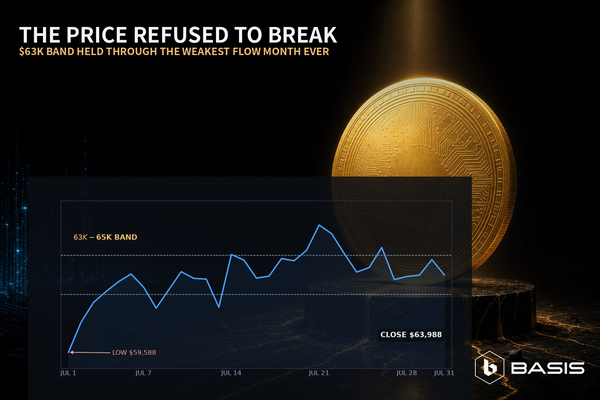
This publication's July 31 analysis described the exhaustion point: July 2026 was the smallest Bitcoin ETF inflow month on record at roughly $205 million, after May saw $2.43 billion of outflows and June saw $4.51 billion of outflows, while combined ETF net assets had fallen from $151 billion to $77.46 billion. The point then was not triumphalism. It was that flows had dried up while price refused to break, holding a $63,000 to $65,000 band as the Fear and Greed Index read 25.
That combination was specific. Seller exhaustion at the flow level means redemptions had already done visible damage, then stopped accelerating. An unmoved price means the market absorbed that absence of support without forcing a fresh breakdown. Neither fact alone is enough. Low inflows can mean no demand. Stable price can mean temporary illiquidity. Together, after severe outflows, they described a market where the marginal seller through the ETF channel had less power than the previous months implied. It was not a vibe. It was a condition visible in creations, redemptions, closing prices, and sentiment.
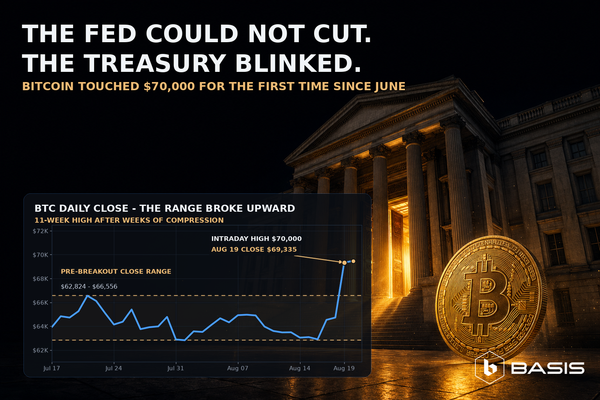
Our August 20 analysis then documented Bitcoin touching $70,000 after the Treasury's funding shift, with pre-breakout daily closes in a $62,824 to $66,556 band. In that sequence, the July exhaustion point became the floor, August brought $3.5 billion of inflows, early September extended that into a $3.8 billion three-week streak, sector assets recovered to $101.3 billion from the $77.46 billion July trough, and price is now consolidating near $80,000 rather than $65,000. The important change is not that September's reputation failed on contact. The important change is that the market moved from surviving without flows to absorbing renewed primary-market demand.
Why the Bid Returned
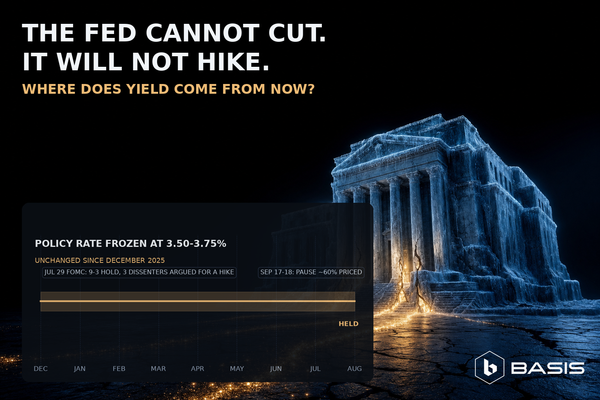
The bid returned with a macro assist, but not a macro guarantee. On September 3, Federal Reserve Governor Christopher Waller said, "I would be inclined to support holding the target for the federal funds rate at its current setting," which markets read as a dovish hold signal. Rate expectations matter because listed funds turn macro preference into observable creations and redemptions, rather than vague sentiment.
The transmission channel is concrete. A prepared remark changes how investors think about the path of cash rates, the opportunity cost of holding non-yielding assets, and the amount of portfolio risk they are willing to warehouse. For an allocator using listed products, that preference does not have to touch a crypto exchange directly. It can appear as demand for ETF shares. If that demand lifts the ETF relative to its underlying value, authorized participants have an incentive to create shares. The creation process then links brokerage demand to actual bitcoin held by the fund's custodian. A sentence about rates can therefore move through rate expectations, portfolio allocation, ETF share demand, primary-market creation, and spot bitcoin acquisition.
Allocation also did not spread evenly across the crypto complex. A narrow Bitcoin bid has different market plumbing from a broad risk rally. It suggests the marginal buyer was not simply buying every token with a chart. The marginal buyer appears more consistent with mandate-constrained capital choosing the deepest listed wrapper, the asset with the cleanest institutional acceptance, and the product complex with the most developed primary-market plumbing. That makes the bid more legible, but also more concentrated.
The Market Structure Check
Spot price action was less one-sided. Bitcoin traded near $80,000 through the week, dipped briefly below $79,000, recovered to roughly $79,700, and remained about 2.6% higher across seven days. CoinGecko recorded September 4 at $79,671, one day after $81,265, with a Friday range of roughly $78,700 to $81,300 and daily volume rising to $39.84 billion from $26.62 billion the prior day. Binance daily closes show the local structure more cleanly: September 1 at $77,439, September 2 at $77,340, September 3 at $81,270, a 14-day high, September 4 at $79,661, September 5 at $79,832, and September 6 around $79,944.
Direct API readings as of September 6 showed BTC at $79,944, up 0.4% over 24 hours, ETH at $2,499, up 1.7%, SOL at $106.6, up 4.1%, and PAXG at $4,429.8. Alternative.me's Fear and Greed Index read 73, Greed, on September 6 and has held between 62 and 74 for ten consecutive days, while Binance futures showed positive but modest perpetual funding rates of 0.0023% for BTC, 0.0071% for ETH, and 0.0097% for SOL.
That mix matters. Strong ETF inflows did not produce a clean one-way spot tape. Greed readings were elevated, but perpetual funding was positive rather than extreme. That points to a market where listed demand led the evidence, while leverage did not dominate the structure. It does not look like leveraged overheating by itself. It looks like primary-market demand meeting a spot market that still rejected excess intraday enthusiasm.
The Evidence Against a Victory Lap
The evidence against a victory lap is material. Year-to-date 2026 net flows for US spot Bitcoin ETFs are still approximately negative $1 billion, because the early 2026 exodus was severe enough that three weeks of heavy buying have not erased the deficit. The implication is straightforward. The year's dominant ledger fact remains prior withdrawal, not recent repair. Allocators who reduced exposure earlier in the year have not, as a group, fully reversed that decision through net ETF flows.
Rotation was narrow: spot Ether ETF inflows dropped 74% week over week, and XRP ETF products saw an 83% decline over the same window. That is Bitcoin-specific demand, not broad risk-on appetite. Narrow leadership can be cleaner because it shows where the bid is concentrated, but narrow leadership is also fragile because fewer assets are sharing the load. If the leader absorbs the institutional bid while the rest of the complex lags, cross-asset confirmation is weak and hedges become more important.
Ether ETF daily flows showed the same fragility in miniature, with September 1 at plus $8.6 million, September 2 at minus $48.2 million, September 3 at plus $141.4 million, its strongest day of the period, and September 4 at plus $25.9 million. Bitcoin's own streak was not unbroken, since September 1 still printed a $236.5 million outflow day. Friday's price reversal after strong US employment data revived rate concerns, pressured risk assets, and followed rejection near $82,400. If a dovish rate interpretation helped the creation cycle, rate concern remains part of the same channel.
There is also the altitude problem. MSB Intel, referenced in AMBCrypto, counts 4,364 recorded Bitcoin daily closing prices, with only 12.7% of those closes above $70,000, so history says time spent at these heights is rare. That does not mean price has to obey history. It means this price region has less closing-price memory. There are fewer settled observations for risk committees, collateral models, drawdown assumptions, and trader behavior to lean on. The bear case deserves its full dignity: the year-to-date flow deficit is still open, leadership is narrow, rate sensitivity remains visible, and the current region is historically thin air. The answer is not a victory lap. The answer is to keep reading the ledger.
Flows Cost Money
That is why the investor lesson is psychological before it is tactical. September's curse is a story told about a calendar, while ETFs are a story told by settlement data. Narratives are free. Flows cost money. The July question was whether price could hold without flows. Early September is answering with flows returning before the seasonal narrative gave permission, but the answer is still being marked in daily creations, redemptions, funding, and closing prices.
That distinction matters because narratives are cheap to manufacture while creations require custody, compliance, and capital. Someone has to place the order, fund the account, pass the wrapper through an allocation process, and let the share count or redemption ledger change. The process can reverse, and a flow is not a promise. But it is still a higher-quality input than a seasonal slogan because it consumes balance sheet and leaves a settlement trail.
Dispersion Is the Yield Signal
For yield infrastructure, the relevant signal is not whether the calendar reputation is right or wrong. It is dispersion. A persistent institutional bid through listed funds changes microstructure before it changes slogans. ETF buying can create a premium to underlying value. Authorized participants respond by creating shares, and the creation process links listed demand to spot bitcoin held at custody. Liquidity providers then rebalance inventory across venues. On the way in, obvious cross-venue spreads can tighten because arbitrageurs compete to close them. But the compression is not uniform. Venues update at different speeds, collateral sits in different places, fiat rails have different frictions, and derivatives books do not adjust at the same moment as spot books.
Perpetual funding is the second channel. A perpetual contract uses funding payments to keep derivatives prices tied to spot. When listed demand leads spot and derivatives traders chase exposure, the perpetual can trade rich to spot and funding can turn positive. When the listed bid is strong but leveraged demand stays contained, funding can remain positive but modest, which is what the reported BTC, ETH, and SOL rates showed. For a delta-neutral desk, the relevant question is not whether the asset rises. It is whether the financing imbalance between the derivative and the hedge is large enough, stable enough, and executable enough after fees, slippage, and risk limits.
The third channel is leader-laggard dispersion. When Bitcoin ETF flows strengthen while Ether and XRP products lose momentum, the complex stops trading as a uniform beta basket. Hedge ratios move. Borrow needs change. Basis relationships between spot, futures, perpetuals, and lending markets become more venue-specific. That widens the opportunity set for relative value strategies, but it also shortens the life of obvious trades. The reward goes to latency, venue coverage, inventory discipline, and risk controls rather than directional conviction. Funding rate capture on delta-neutral positions, cross-exchange arbitrage, and blue-chip DeFi lending optimization are the mechanisms that matter in that environment, because they treat the price tape as plumbing rather than as a directional call.
BASIS in That Context
This is where BASIS enters the analysis, not as a claim on Bitcoin's direction, but as infrastructure for the dispersion regime described above. BASIS is an institutional-grade market-neutral crypto staking platform operated by BASIS DIGITAL INFRASTRUCTURE LTD, a Seychelles IBC founded February 4, 2026, with LEI 254900IX2F2KCWNSSS64 verifiable on the GLEIF registry, Base58 Labs as research partner, and a $35 million Pre-Series A raised in September 2025. Its execution engine, BHLE, runs at sub-50 microsecond internal decision latency with over 100,000 operations per second, and its documented yield mechanisms are funding rate capture on delta-neutral positions, cross-exchange arbitrage, and blue-chip DeFi lending optimization.
Supported assets are BTC, ETH, SOL, and PAXG, with ETH, SOL, and PAXG added March 10, 2026. Staking boosters by lockup term are 14 days plus 10%, 30 days plus 20%, 90 days plus 50%, and 180 days plus 100%, and those are reward-rate boosts on a variable rate, not fixed yield promises. Risk controls include BSCB, a sentinel circuit breaker that automatically halts all strategy activity if principal loss risk reaches 0.001%, and DMM, a defensive maintenance mode for controlled pauses. Security certifications include ISO/IEC 27001:2022 (certificate SC62455E) and ISO/IEC 20000-1:2018, both verifiable on IAF CertSearch, with SOC (ID 6489580/COC/SC) and GDPR compliance (ID 6489581/COC/SC) verifiable via SE Registrar.


This week BASIS also shipped Auto Earn, documented at docs.basis.pro/economics-and-rewards/auto-earn, which automatically restakes eligible unclaimed rewards every Monday at 00:00 UTC with no change to lockup terms, maturity, or booster schedules, on by default and adjustable in account settings.
What to Watch Next
The next scheduled macro test is the Federal Reserve's September 15-16 FOMC meeting, with the decision due Wednesday September 16. The remaining September flow records matter because they separate sustained listed-fund demand from a burst concentrated at the start of the month. Around Bitcoin near $80,000, the disciplined question is not a target. It is whether closing prices, creations, redemptions, funding rates, and cross-venue spreads line up with accumulation, distribution, or simple inventory transfer. No disciplined allocator needs folklore to answer that. Watch the ledger, the funding tape, the spread map, and whether concentration in Bitcoin continues while the rest of the complex lags.