When Fear Stops Trending: The Case for Market-Neutral Yield in Bitcoin's Rangebound Market


Bitcoin is not trading like an asset in free fall. It is trading like an asset that has lost sponsorship, at least temporarily.
Fear without capitulation
Over the past 14 days, the Crypto Fear and Greed Index has ranged from 20 to 29, registering Fear or Extreme Fear every single day. There were zero days in Neutral or Greed territory. Yet over the past 30 days, Bitcoin has remained confined to a narrow band between approximately 60,024 and 64,806 dollars, repeatedly failing below 65,000 and recording no daily close above that level. The historical resistance zone near 73,000 to 80,000 has not been retested.
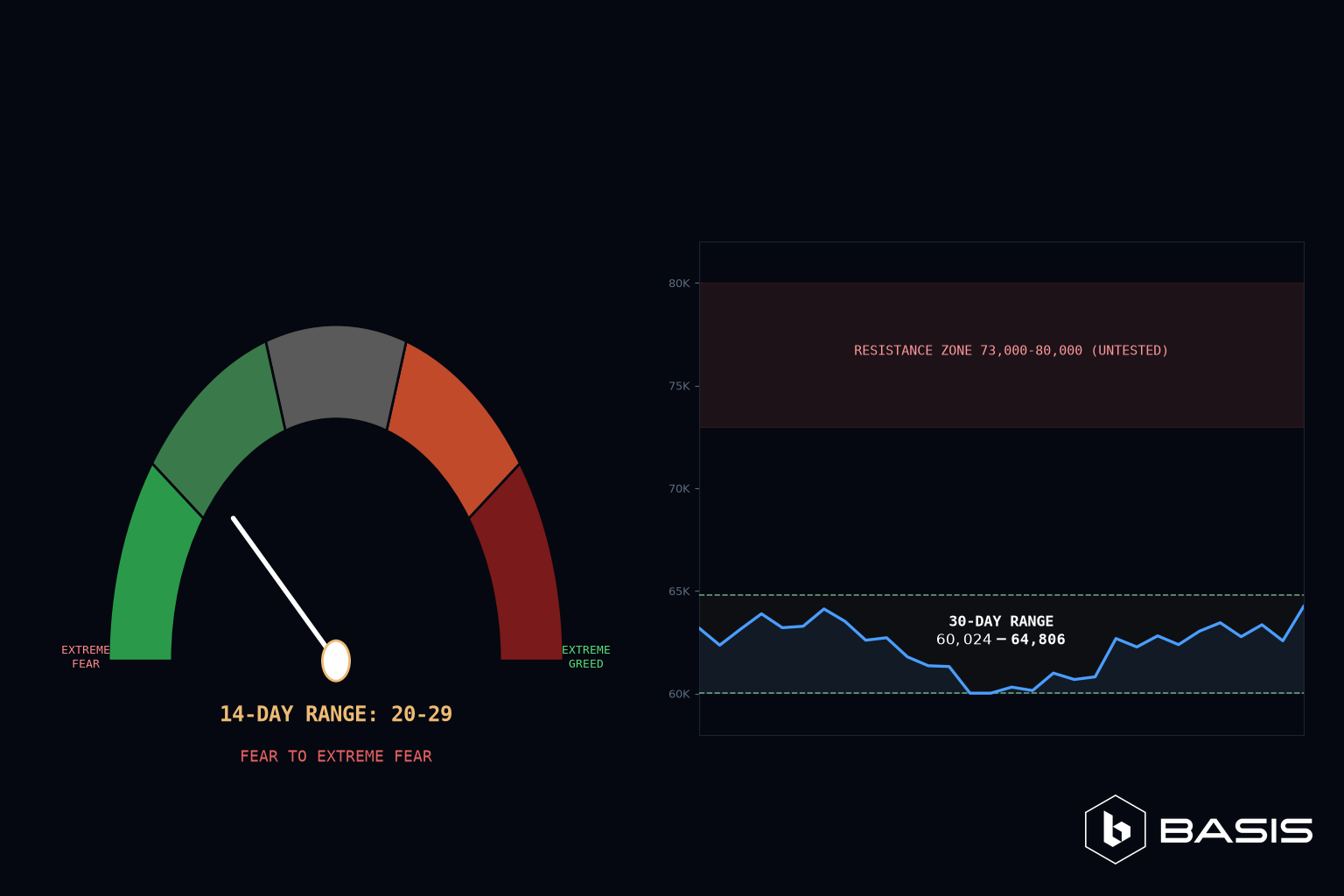
That combination matters. Sustained fear usually implies either capitulation or a violent repricing. This market has delivered neither. Instead, it has produced a low-volatility chop that is hostile to directional conviction. Bulls get lured into local strength, only to see rallies fade before meaningful follow-through. Bears press weakness, then face mean reversion before a clean breakdown develops. The tape is weak enough to discourage spot accumulation, but not weak enough to reward aggressive shorts.
For directional traders, that is a poor payoff environment. False breakouts become frequent because local momentum lacks sponsorship. Stops are triggered on both sides because price moves just far enough to force action, but not far enough to establish trend. Funding and borrow costs can consume what little edge exists in short duration directional trades. Psychological fatigue compounds the problem. A market that refuses to trend does not merely frustrate traders, it degrades process by encouraging overtrading, premature de-risking, and late entries after already exhausted moves.
The equity backdrop makes the crypto underperformance more striking. During the same window in which Bitcoin remained rangebound, the S&P 500 posted its best quarterly gain since Q2 2020. Bitcoin often trades as a risk asset when liquidity and animal spirits are expanding. Its failure to participate in that rally suggests the current constraint is not simply macro risk appetite. Something more specific is weighing on crypto market structure.
ETF flows point to distribution, not disorder
The institutional flow picture helps explain why the range has been so difficult to break.
Bitcoin ETF flows have reversed from over 500,000 BTC of cumulative net inflows in 2024 to approximately 120,000 BTC of cumulative net outflows as of mid-2026. That is not, by itself, evidence of panic. Panic selling tends to appear as disorderly liquidation, widening discounts, and indiscriminate risk reduction. The current picture is more consistent with profit-taking, portfolio rotation, or methodical de-risking by institutional allocators.
That distinction is critical. Panic can create tradable capitulation. Orderly distribution is different. It places supply into rallies, dampens breakout attempts, and forces the market to absorb inventory without necessarily producing a dramatic collapse. In that environment, the absence of a clean upside catalyst matters as much as the lack of downside acceleration. A market can remain bid enough to avoid breakdown and still lack the marginal buyer required to attack prior resistance.
This is where the case for market-neutral yield becomes structural rather than merely defensive. If professional capital is trimming exposure rather than abandoning the asset class, then the rational response may not be to bet on immediate reversal or breakdown. It may be to harvest the internal mechanics of the market while waiting for direction to clarify.
Why directional strategies struggle in this regime
Directional strategies work best when price movement is both large enough and persistent enough to compensate for execution costs, financing costs, and error. The current Bitcoin regime offers the opposite. The range between roughly 60,024 and 64,806 has been wide enough to punish leverage, but too narrow to reward patient trend-following. No daily close above 65,000 has arrived to validate upside continuation. The 73,000 to 80,000 resistance zone remains distant and untested.
For long only traders, the problem is not merely that sentiment is fearful. Fear can be attractive when price is dislocated and positioning is washed out. The problem is that fear has persisted without producing a decisive clearing event. Buying each dip requires confidence that the range floor will hold. Chasing each bounce requires confidence that 65,000 will finally give way. Neither condition has been confirmed.
For short sellers, the setup is also uncomfortable. Fear readings in the 20 to 29 zone suggest pessimism is already embedded. When bearish consensus is high but price refuses to break, shorts are vulnerable to sharp reversals inside the range. These reversals do not need to become bull markets to be painful. They only need to move far enough to force covering.
Leverage worsens both sides. Perpetual futures funding costs, borrow rates, and liquidation thresholds matter more when the expected directional payoff is compressed. A trader may be directionally correct for a few hours, then lose the trade because the market mean-reverts before the move matures. In a trending market, financing is often a secondary consideration. In chop, it becomes central.
The result is a market where the most visible trade, guessing the next breakout or breakdown, may be the least efficient expression of risk.
Funding rate capture: earning from imbalance rather than direction
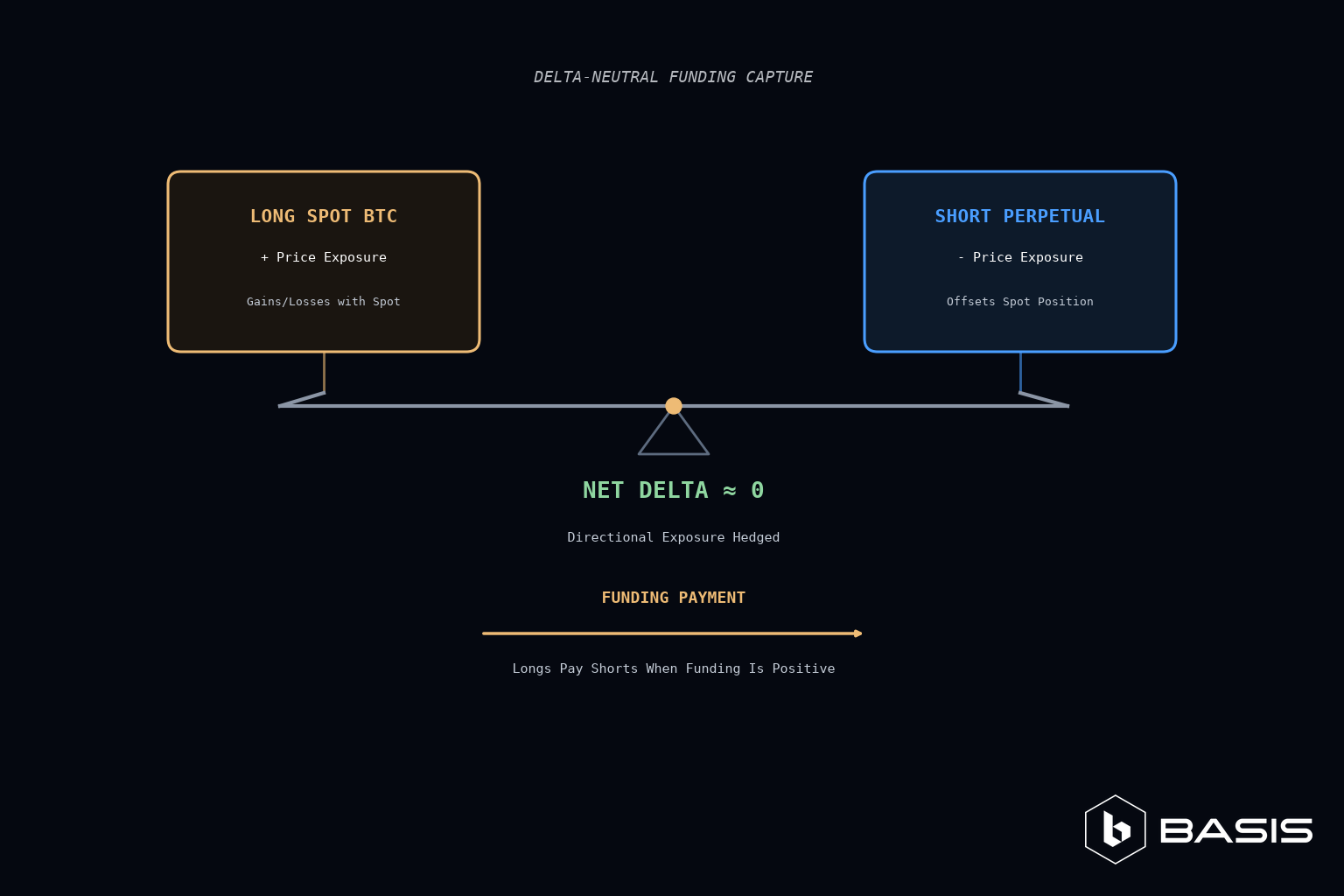
Perpetual futures are designed to track spot prices without having an expiry date. Because there is no settlement date forcing convergence, exchanges use funding payments to anchor the perpetual contract to the underlying spot market. When the perpetual trades above spot, funding is typically positive and longs pay shorts. When the perpetual trades below spot, funding is typically negative and shorts pay longs. The rate is set by each venue according to its own methodology and paid at regular intervals.
This creates a source of return that is different from price appreciation. A market-neutral funding strategy seeks to earn the payment created by the imbalance between leveraged long and short demand. When funding is positive, the common construction is to hold long spot exposure while shorting the perpetual future. The long spot position gains or loses with Bitcoin, while the short perpetual loses or gains in roughly equal measure. The directional exposure is hedged, and the intended return comes from the funding paid by longs to shorts.
When funding turns negative, the structure can be inverted where liquidity, borrow terms, and risk controls allow. A manager can use a long perpetual position against a short spot or another offsetting futures leg, capturing payments from shorts to longs while maintaining low net delta. The point is not that funding is always positive. It is that funding oscillates because positioning oscillates.
Even in a fear-dominated and rangebound market, these oscillations persist. Hedgers add shorts when price weakens. Leveraged longs return when price bounces. Dealers adjust inventory. Retail participation thins and then reappears around local levels. None of this requires Bitcoin to break out of the range. It only requires the perpetual market to periodically trade at a premium or discount to spot.
This is why funding capture can remain relevant whether a future Bitcoin quote is near 60,000, 90,000, or somewhere else. In a properly hedged structure, the level of Bitcoin is not the main driver of the return. The spread between the instruments is. The key risks are execution slippage, funding reversals, borrow costs, collateral management, and venue reliability. A market-neutral strategy must manage those risks continuously, because delta neutrality is not a static condition. It has to be maintained.
Cross-exchange arbitrage: harvesting fragmentation when risk appetite thins
Crypto remains a fragmented market. Bitcoin, Ethereum, Solana, and tokenized gold can trade across multiple venues with different order books, user bases, fee schedules, collateral rules, and liquidity conditions. Even when headline volatility is low, those differences create temporary price discrepancies.
Fear can make these discrepancies more persistent, not less. When retail volume thins, order books become less resilient. When market makers become more risk-averse, they may widen spreads or reduce inventory. When transfers between venues are constrained by settlement time, internal risk limits, or withdrawal processes, arbitrage capital cannot always eliminate price gaps instantly.
Cross-exchange arbitrage seeks to buy the asset where it is cheaper and sell it where it is more expensive, ideally at the same time. The intended profit is the spread after fees, financing, and operational costs. The directional move in the asset is not the target. If both legs are executed properly, the strategy is exposed primarily to convergence and execution quality rather than whether Bitcoin rises or falls.
The mechanism is simple in concept and demanding in practice. A system needs inventory or collateral on multiple venues so it can act without waiting for asset transfers. It needs fast routing to avoid being legged, meaning filled on one side while the other side moves away. It needs real-time risk controls to account for fees, latency, order book depth, and venue-specific constraints. A price discrepancy that looks attractive on a screen may disappear after transaction costs or may be too shallow to execute at institutional size.
This is also where a rangebound market can be productive. Directional traders may see no opportunity because the daily chart is stagnant. An arbitrage system sees microstructure. The asset can spend weeks between 60,024 and 64,806 while venue-level spreads still open and close throughout the day. The return source is not the breakout. It is the friction inside the market.
Blue-chip DeFi lending: yield from borrowing demand, not asset appreciation
Lending markets generate yield through borrower demand. In DeFi lending protocols, asset suppliers deposit collateral into pools. Borrowers draw assets from those pools and pay interest. Rates generally respond to utilization, meaning the share of supplied assets that borrowers are using. When demand to borrow rises relative to supply, rates tend to rise. When demand falls, rates tend to decline.
The yield does not require the underlying asset to appreciate. A lender earns because another participant is paying to borrow liquidity. That borrower may be maintaining leverage, hedging exposure, financing a basis trade, avoiding the sale of collateral, or shorting an asset. During uncertainty, that demand can remain robust or even increase. Traders often need financing most when markets are unclear, because they are trying to hold positions through volatility or protect portfolios without fully exiting.
There is a necessary caveat. Lending an asset is not automatically market-neutral if the lender remains exposed to the asset's price. Supplying ETH, SOL, BTC-linked assets, stablecoins, or tokenized gold can generate interest, but the fiat value of the position may still fluctuate. A market-neutral construction addresses this by pairing lending exposure with hedges where appropriate, or by using lending markets as one component of a broader collateral and funding stack.
In that structure, DeFi lending becomes another spread engine. The portfolio is not relying on Ethereum near 1,864, Solana near 76, PAX Gold near 4,020, or Bitcoin near the current range to appreciate. It is relying on borrowers continuing to pay for liquidity. The relevant questions become protocol quality, collateral rules, oracle design, liquidity depth, withdrawal conditions, and smart contract risk. These are not trivial risks. They are simply different from the risk of guessing price direction.


BSCB circuit breaker logic: neutrality requires a stop mechanism
Market-neutral strategies can be misunderstood as low-risk by default. That is too generous. They are lower directional risk when built correctly, but they introduce other risks: execution failure, hedge slippage, exchange outages, liquidity gaps, protocol failures, sudden funding reversals, collateral impairment, and model drift. The phrase market-neutral describes an objective, not a guarantee.
This is why circuit breaker logic matters. BASIS's BSCB framework is designed conceptually as an automatic halt mechanism triggered at a 0.001 percent principal loss detection threshold. The purpose of such a low threshold is not to wait for a visible drawdown. It is to detect early evidence that the portfolio is no longer behaving as intended.
At a conceptual level, a circuit breaker monitors whether principal integrity has been compromised. If the system detects a loss at or beyond the threshold, it can halt new deployment, stop compounding, cancel nonessential open orders, restrict fresh exposure, and move the portfolio into a capital-preservation state. The details of how those checks are implemented are proprietary, but the logic is straightforward: when a regime shift begins, time is risk.
This does not make losses impossible. No risk control can. It does, however, change the response function. Instead of allowing a hedged strategy to drift into an unhedged one during stress, the circuit breaker forces the system to pause when observed behavior deviates from expected behavior. In market-neutral trading, that pause can be as important as the trade itself.
The historical precedent: consolidation is not invalidation
The existence of a range does not settle the long-term case for Bitcoin, gold, or any other scarce asset. History is less tidy than that.
Gold has experienced past multi-year drawdown and consolidation periods before resuming appreciation when macro conditions shifted. Those shifts can involve real rates, currency dynamics, policy expectations, liquidity, or investor demand for stores of value. The lesson is not that gold always moves on a convenient schedule. It is that a long-term monetary thesis can coexist with long stretches of poor tactical price action.
Bitcoin has shown a comparable pattern in its own history. Extended consolidations have often preceded eventual trend resumption once liquidity, positioning, adoption, or market structure changed. That does not provide a timeline, and it does not justify a specific target. It does suggest that investors should separate two questions that are often conflated: whether an asset has long-term strategic relevance, and whether directional exposure is the best way to express that view right now.
At the moment, Bitcoin's tactical picture is constrained. Fear sentiment is persistent. The range remains intact. ETF flows suggest distribution rather than accumulation. The S&P 500's strong quarter has not translated into crypto momentum. A directional investor may still choose to hold spot exposure for strategic reasons, but the tactical market is not rewarding the repeated attempt to force a trend.
Why the market-neutral conclusion follows
The current regime favors strategies that do not require the investor to answer the hardest question in the room: whether Bitcoin breaks higher, breaks lower, or continues sideways.
Funding capture can generate return from the imbalance between perpetual futures and spot markets. Cross-exchange arbitrage can generate return from fragmented liquidity and venue-level price discrepancies. Blue-chip DeFi lending can generate return from borrowers paying for liquidity. None of these mechanisms depends primarily on Bitcoin reclaiming the 73,000 to 80,000 resistance zone, losing the current range, or following the S&P 500 higher.
That is the analytical basis for BASIS's approach. BASIS runs a market-neutral strategy across BTC, ETH, SOL, and PAXG simultaneously, rather than requiring a single directional view on Bitcoin or a call on which crypto sector will outperform. The multi-asset structure matters because the opportunity set is not limited to one chart. Funding dislocations, exchange spreads, and lending demand can appear differently across Bitcoin, Ethereum, Solana, and tokenized gold exposure.
The operational layer is also relevant. BASIS's execution infrastructure, BHLE, operates with sub-50 microsecond latency and over 100,000 operations per second. BASIS also holds ISO/IEC 27001:2022 information security certification, Certificate SC62455E, and ISO/IEC 20000-1:2018 IT service management certification, both verifiable via IAF CertSearch. These facts do not remove market risk. They speak to the infrastructure and controls required to run a strategy whose edge depends on execution precision, system availability, and disciplined risk limits.
The broader point is not that market-neutral yield is a substitute for every form of crypto exposure. It is that, in this specific environment, it is aligned with the structure of the market. Fear is elevated but not capitulatory. Price is rangebound but not broken. Institutions appear to be de-risking methodically rather than fleeing. Equity markets have rallied without pulling Bitcoin higher.
When the market refuses to pay traders for directional conviction, the spread becomes the asset.