When Crypto Fear Hits 12 Out of 100, What Happens to Your Staking Yield?

When Crypto Fear Hits 12 Out of 100, What Happens to Your Staking Yield?
1. Extreme Fear is no longer theoretical
The crypto market is not mildly nervous. It is in Extreme Fear.
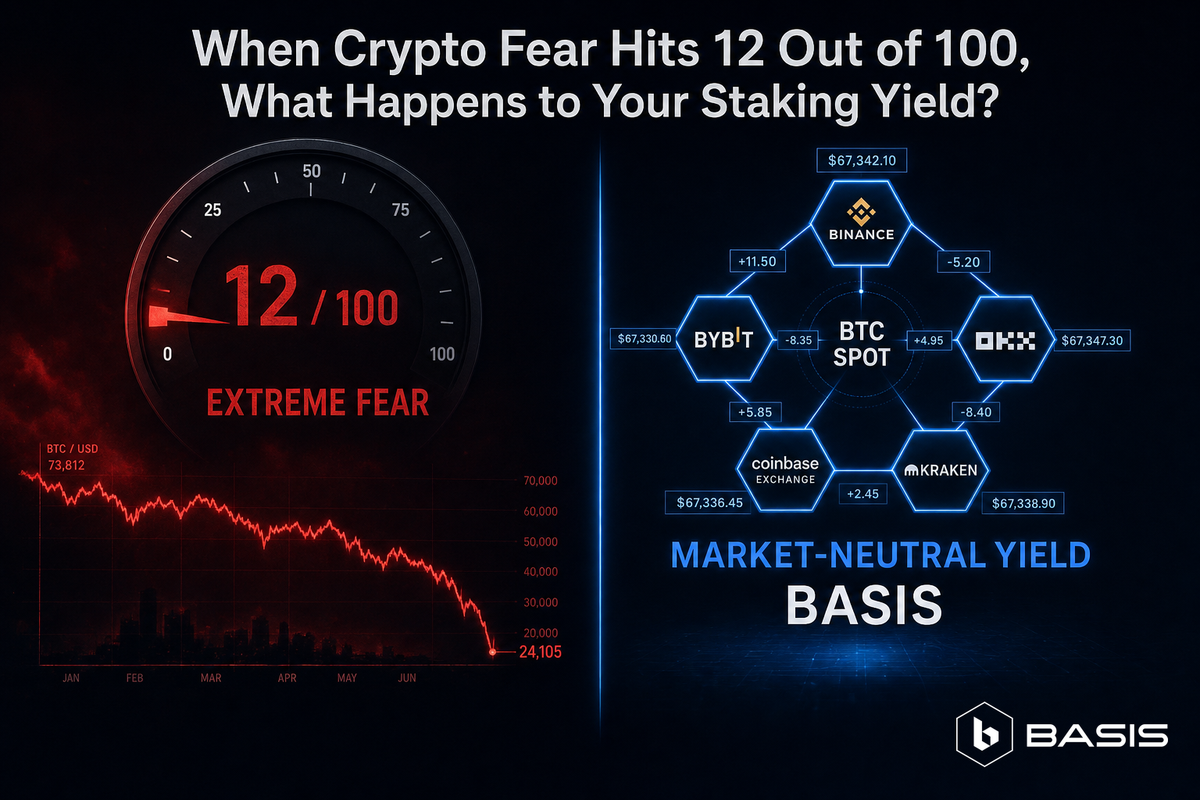
As of June 11, the Crypto Fear and Greed Index is at 12 out of 100, after 14 consecutive days in Extreme Fear. The most acute readings have clustered between 8 and 12, with June 10 at 9, June 9 at 10, June 8 at 8, and June 11 at 12.
Price confirms the mood. BTC is at $63,101, up 3.37% in the last 24 hours, but still coming off a sharp 13-day decline from $73,617 on May 29. The verified market data describes that move as a 16.9% drop. ETH is at $1,666, up 2.86% on the day, but down 10.2% from its June 3 level of $1,856. SOL is at $65.89, up 3.70% in 24 hours, but still below its June 3 level of $73.97.
For most investors, this is not an abstract macro regime. It is a portfolio screen full of red. It is the realization that a 3% daily bounce does not repair a double-digit drawdown. It is the uncomfortable gap between annual yield assumptions and weekly mark-to-market losses.
The question is no longer simply, “Where does BTC go next?”
The better question is: what happens to yield when fear becomes the dominant market structure?
That distinction matters. Directional investors need price recovery. Market-neutral infrastructure needs dislocation, funding asymmetry, liquidity fragmentation, and execution discipline. Those are very different sources of return.
BASIS exists for the second category. It does not predict the direction of BTC, ETH, SOL, or PAXG. It is a research-driven structural alpha platform built from the work of Base58 Labs, designed to capture objective inefficiencies across venues, funding markets, liquidity pools, and execution paths.
In a fear regime, that distinction becomes critical.


2. What the Fear Index is really measuring
A Fear and Greed reading of 12 is often described as sentiment, but that understates what the market is actually telling you.
At this level, fear is not just an emotional input. It is visible in market microstructure. It shows up in forced selling, thinner liquidity, wider spreads, unstable order books, and changes in perpetual funding.
The current funding picture is instructive.
BTC funding over the recent eight sessions has ranged from -0.0034% to +0.0030%, effectively near neutral. That suggests the BTC perpetual market is not aggressively paying one side in a sustained way. The leverage impulse is muted. Participants are not showing a strong, persistent willingness to pay for long exposure, but the market is also not showing a clean, one-way shorting premium.
ETH looks different. Recent ETH funding has ranged from -0.0046% to +0.0008%, mostly negative. In plain terms, shorts have been dominating the ETH perpetual market. That is consistent with the price action, ETH fell from $1,856 on June 3 to $1,581 on June 6, before recovering to $1,666 on June 11.
Negative funding is not just a sentiment marker. It changes the economics of delta-neutral positioning. When funding is positive, the classic spot-long and perpetual-short structure can receive funding from long-side demand. When funding turns negative, the structure may need to reverse, subject to borrow availability, execution quality, collateral conditions, and liquidation controls.
That is why a fear reading of 12 should not be read as a simple “everyone is bearish” headline. It is a regime signal.
It says:
- Risk appetite has contracted.
- Liquidity is less reliable.
- Perpetual positioning has shifted.
- Price discovery is more fragmented.
- Execution quality matters more than directional conviction.
In other words, Extreme Fear is not only a psychological condition. It is an operating environment.
3. The directional investor’s dilemma
For a directional investor, fear regimes create a harsh arithmetic problem.
Anyone who bought BTC near $73,000 is roughly 14% underwater with BTC now at $63,101, even after the latest 3.37% daily rebound. ETH holders who bought at $2,400 are down more than 30% at $1,666. Even buyers near the June 3 ETH level of $1,856 are down 10.2%.
This is where conventional staking yield feels painfully small.
Lido stETH APY is currently 2.39%, according to the provided DeFiLlama live data. That is about 0.0065% per day. There is nothing wrong with that yield as a baseline liquid staking rate, but it is not built to offset violent principal drawdowns.
If ETH drops 10% in a week, a 2.39% annual APY does not protect the position. It only slightly slows the bleeding. If the asset falls 30% from an entry price, the yield is not the primary driver of outcome. Direction is.
This is the directional investor’s dilemma in its purest form:
You can be earning yield and still be losing money in economic terms.
That is not a failure of staking. It is a mismatch between the size of the yield and the volatility of the underlying asset. A 2.39% APY is a yield layer on top of ETH beta. It does not neutralize ETH beta.
This is why market-neutral design matters. A market-neutral platform is not trying to solve the question, “Will ETH recover?” It is trying to solve a different question, “Are there structural inefficiencies that can be captured while minimizing directional dependence?”
BASIS is built around that second question.
4. How structural arbitrage behaves in fear regimes
The core insight is simple, but often missed: cross-venue price dislocations do not disappear in fear regimes. They can widen.
Panic selling is not evenly distributed. One venue may experience heavier sell pressure than another. One order book may thin faster. One liquidity pool may lag. One transfer rail may become temporarily less useful. One market maker may reduce inventory on a specific exchange, while another venue still has executable depth.
That fragmentation creates temporary price gaps.
BASIS’s Spatial Arbitrage, identified in the strategy matrix as BQAE Core, is designed to scan for these cross-venue dislocations. The objective is not to guess whether BTC, ETH, SOL, or PAXG will rise tomorrow. The objective is to identify a temporary spread between venues and execute only when the spread is real enough to survive costs, slippage, and unwind risk.
The execution rules matter. According to BASIS documentation, BQAE executes only when:
- Executable depth is sufficient.
- Modeled slippage is below the target spread.
- Venue status and transfer rails are healthy.
- Expected unwind paths remain open.
That last point is especially important in fear regimes. A quoted spread is not the same thing as a realizable spread. In stress, markets can show attractive prices that cannot be safely executed at size, or cannot be unwound without unacceptable loss risk. BASIS’s infrastructure, including sub-50 microsecond latency, 100K+ OPS, and proprietary routing, is designed around precision, but precision is paired with constraints.
The Bellman-Ford graph concept helps explain the logic.
In this framework, nodes represent assets on specific venues. An example node might be BTC on Venue A, ETH on Venue B, or USDT on Venue C. Edges represent tradable conversions between nodes. Those conversions include the economic cost of the trade, such as price, fees, modeled slippage, and route feasibility.
A profitable arbitrage route appears as a negative-weight cycle after the pricing graph is transformed for detection. In practical terms, that means the system can start with one asset, move through a sequence of executable trades, and finish with more of the starting asset after modeled costs.
Fear can increase the number of candidate cycles because markets fragment under stress. But it also increases the number of false positives. A spread can appear attractive before slippage. A venue can look cheap because liquidity has vanished. A route can look profitable before transfer risk is considered.
That is why BASIS is not unmanaged arbitrage. The edge is not merely finding a price gap. The edge is determining whether the gap is executable, size-appropriate, and safely unwindable.
Funding markets add a second layer.
BASIS’s Delta-Neutral Funding Stream uses spot-long and perpetual-short structures, or the reverse, to capture funding transfers and basis convergence. The current ETH environment is relevant because ETH funding has been mostly negative, ranging from -0.0046% to +0.0008% across the recent four sessions. When funding is negative, the market is signaling that shorts dominate and are paying to maintain that pressure. A delta-neutral system may adjust orientation to capture that transfer from the side being paid, while controlling liquidation risk and execution precision.
This is not risk-free. BASIS documentation is explicit on that point. Funding regimes can change. The perpetual leg can face liquidation risk. Execution precision can fail. Venue risk remains real.
But structurally, this is the difference between directional yield and structural yield. Directional yield needs the asset to recover. Structural alpha seeks to monetize inefficiencies that can become more active when fear disrupts normal market balance.
5. The BASIS risk model under stress
A serious market-neutral platform should never pretend that extreme markets are easy.
Fear regimes can break assumptions. Liquidity can vanish. Venue behavior can deteriorate. Transfer rails can become unreliable. Funding can flip. Spreads can widen for the wrong reason, because one side of the market is becoming impossible to exit.
This is why BASIS uses a three-state risk model:
- Normal, all systems healthy and execution continues within limits.
- BSCB, or Basis Sentinel Circuit Breaker, a protective pause for the affected scope when loss risk or instability is detected.
- DMM, or Defensive Maintenance Mode, a halt of all automated activity requiring operator review.
BSCB is designed to stop new entries for the affected scope. It may also reduce existing exposure where appropriate. The point is not to keep trading because the model found an apparent opportunity. The point is to stop when market conditions make the opportunity unsafe.
DMM is stronger. It halts all automated activity. Return from DMM requires reconciliation, venue and control validation, and explicit operator re-enable.
This is a critical design choice.
Many failures in crypto are not caused by the absence of opportunity. They are caused by systems that continue operating after the environment has changed. A spread model that works in normal conditions can become dangerous if it ignores venue instability. A funding strategy can become dangerous if it ignores liquidation dynamics. A routing engine can become dangerous if it assumes transfer paths remain open when they do not.
The BASIS philosophy is different. A system that can stop is more trustworthy than one that is forced to keep trading through chaos.
That is not a yield-maximizing slogan. It is a capital preservation principle.
6. Lock-up economics in context
BASIS offers flexible access and lock-up tiers. The economics are straightforward:
- Flexible pool, lower yield because it reserves liquidity.
- 14-day lock, +10% booster.
- 30-day lock, +20% booster.
- 90-day lock, +50% booster.
- 180-day lock, +100% booster, a 2x multiplier.
These boosters are not guaranteed APY. BASIS documentation is clear that boosters reflect the economic value of predictable lock-up capital.
That distinction matters more in fear regimes than in calm markets.
Flexible capital has optionality. It can leave quickly. To support that, a system needs to reserve more liquidity and operate with more conservative deployment assumptions. Locked capital is different. It gives the strategy engine more predictability. It allows better planning. It reduces the need to hold excessive liquidity buffers for immediate withdrawals. It can support deeper deployment into structural alpha opportunities when execution conditions meet the model’s requirements.
In a fear regime, that predictability can become more valuable. Dislocations may be more frequent, but they are not always available at the exact moment flexible capital arrives. A strategy engine benefits from knowing what capital it can plan around, what capital must remain liquid, and what capital can be assigned to longer-horizon structural opportunities.
The booster system is therefore an economic redistribution mechanism. It shares additional value with users who provide the platform with more predictable capital. It is not a marketing promise that fear automatically raises yield. It is an incentive structure aligned with how market-neutral infrastructure actually deploys capital.
BASIS’s published materials cite a DRR range of 0.05% to 0.15% daily, but BASIS is not a fixed-return product. It is not a bank account, not a traditional investment fund, not directional trading, and not unmanaged arbitrage.
7. PAXG in fear regimes
PAXG is at $4,083 today, down 1.62% over 24 hours, and it tracks gold.
That makes it a different instrument from BTC, ETH, and SOL in a fear regime. Historically, gold has tended to hold value or appreciate during periods of broad risk aversion. That does not mean gold-linked exposure is riskless. Today’s PAXG move is a reminder that even safe-haven assets fluctuate. But the portfolio role is different.
For a crypto investor sitting on drawdowns, PAXG offers a distinct profile:
- Gold-linked exposure through PAXG.
- BASIS stToken structure through stPAXG.
- Participation in market-neutral structural alpha rather than pure directional crypto beta.
On BASIS, PAXG converts to stPAXG at a 1:1 quantity structure, and rewards accrue in the same stToken. The same structure applies across BTC to stBTC, ETH to stETH, and SOL to stSOL.
This is not the same as holding spot BTC and waiting for recovery. It is not the same as staking ETH at 2.39% APY while remaining fully exposed to ETH price movement. A PAXG position on BASIS combines gold-linked exposure with the platform’s market-neutral reward framework.
For investors who want to reduce reliance on crypto direction while staying inside digital-asset infrastructure, that combination is differentiated.
8. What to monitor right now
Fear regimes do not normalize all at once. They normalize through signals. The current market gives investors several concrete indicators to watch.
1. Fear Index recovery toward 25+
The current reading is 12. A move back toward 25+ would indicate that the market is leaving the most acute phase of Extreme Fear. It would not mean risk has disappeared, but it would show that panic conditions are easing.
2. BTC reclaiming $65,000
BTC is currently $63,101. A reclaim of $65,000 would not erase the decline from $73,617, but it would indicate that buyers are absorbing supply above the current range. In a market dominated by fear, even modest reclaim levels matter because they test whether bounces are being sold immediately.
3. ETH funding turning positive
ETH funding has recently ranged from -0.0046% to +0.0008%, mostly negative. If ETH funding turns consistently positive, it would suggest that demand for leveraged long exposure is returning. For delta-neutral funding strategies, it would also alter which side of the market is economically attractive.
4. DeFi TVL stabilization above $70 billion
Total DeFi TVL is currently $71.0 billion. Stabilization above $70 billion would suggest that collateral is not fleeing DeFi in a disorderly way. Solana DeFi TVL is $4.59 billion, which is also relevant given SOL’s decline from $73.97 on June 3 to $65.89 on June 11.
5. Funding neutrality in BTC
BTC funding has been nearly neutral, between -0.0034% and +0.0030% across recent sessions. A move away from neutrality would tell investors whether leverage is returning on the long side or whether short pressure is intensifying.
These are not prediction tools. They are regime tools. They help investors distinguish between a market that is still in panic liquidation and a market that is rebuilding two-sided liquidity.
9. Fear is real. Infrastructure matters.
Extreme Fear is not irrational when portfolios are down. Losses are real. Liquidity is fragile. A 24-hour bounce does not erase the damage of a 13-day drawdown.
The mistake is not feeling fear. The mistake is using the wrong infrastructure for the regime.
If your strategy depends entirely on BTC, ETH, or SOL going up, then Extreme Fear is a waiting room. You wait for buyers. You wait for funding to normalize. You wait for liquidity to return. You wait for the chart to repair itself.
A market-neutral structural alpha platform is built for a different problem. BASIS does not predict direction. It seeks to capture price gaps across venues, funding differentials, liquidity fragmentation, and execution precision opportunities. It also includes risk states that are designed to pause or halt activity when conditions become unsafe.
That combination matters.
Fear can create opportunity, but only for systems that can distinguish executable inefficiency from dangerous instability. The real question is whether your yield infrastructure is built to operate through fear, or whether it is built to break inside it.
For investors evaluating market-neutral staking infrastructure, BASIS is available at [basis.pro](https://basis.pro). Deposits are 0%, withdrawals are 0.05%, swaps are 0.01%, and KYC is not required. Public trust anchors include BASIS DIGITAL INFRASTRUCTURE LTD, Seychelles IBC, LEI 254900IX2F2KCWNSSS64, ISO/IEC 27001:2022 certification SC62455E, ISO/IEC 20000-1:2018 certification, SOC cert ID 6489580/COC/SC, GDPR cert ID 6489581/COC/SC, and Base58 Labs LTD, UK Companies House No. 17094713.